
Pourquoi les publicités de jeux rétro révèlent les débuts de l'évolution du jeu vidéo
Annonces
Retro game advertisements reveal gaming’s early evolution in ways that dry hardware spec sheets and corporate financial reports simply never could.
Before digital storefronts, streaming showcases, and algorithmic trailers existed, print magazines, arcade flyers, and Saturday morning television commercials served as the primary bridge between pioneering engineers and curious consumers.
Leafing through a 1978 issue of Byte or a 1991 copy of Electronic Gaming Monthly uncovers far more than nostalgic pixel art or cheesy taglines.
Those glossy pages capture an industry figuring out what interactive entertainment actually was, who wanted to buy it, and how to convince skeptical households that a plastic box belonged next to the family television.
From family-friendly living room board game replacements to aggressive teenage rebellion campaigns, vintage marketing materials function as time capsules of technological anxiety, cultural shifts, and fierce corporate survival.
Annonces
What You Will Discover in This Analysis:
- How early home console campaigns positioned video games as wholesome family appliances before shifting toward youth culture.
- Why exaggerated box art and imaginative magazine spreads compensated for severe 8-bit and 16-bit graphical limitations.
- How fierce console wars transformed advertising into bold comparative warfare during the late 1980s and early 1990s.
- A decade-by-decade breakdown of how hardware leaps directly reshaped marketing language and visual design.
- Answers to common questions regarding the preservation, historical accuracy, and cultural impact of vintage gaming ads.
How Did Early Print Ads Define Video Games for First-Time Buyers?
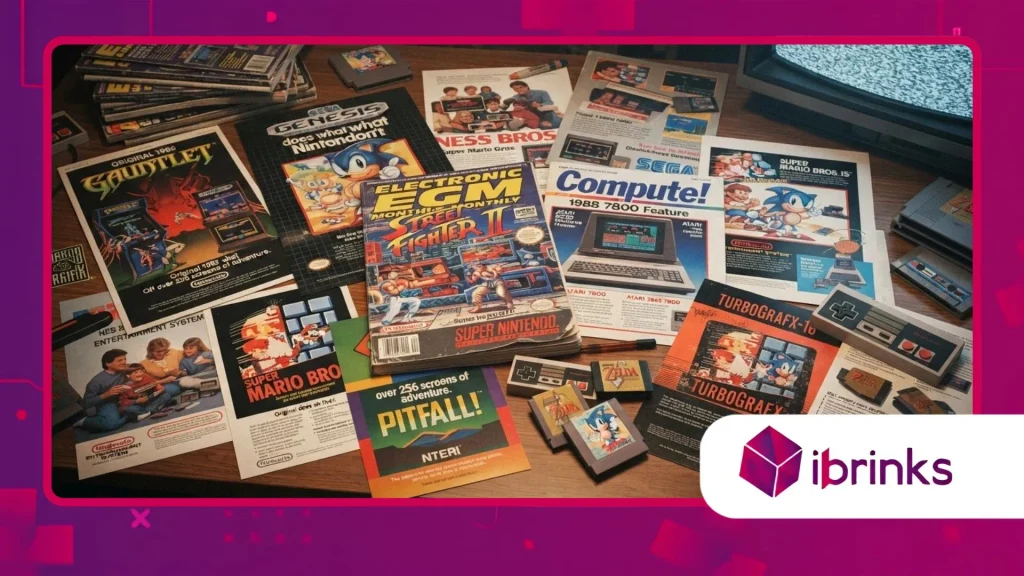
Why Did 1970s Console Ads Focus on Family Living Rooms?
Early home console manufacturers faced a massive consumer education hurdle because most households viewed television strictly as a passive broadcast medium.
Companies like Magnavox and Atari designed print campaigns for the Odyssey and the VCS that featured smiling parents, grandparents, and children gathered neatly around a wooden console TV.
These advertisements deliberately avoided technical jargon like microprocessors or kilobytes, framing video games instead as an upgraded, electronic version of traditional parlor games like Monopoly or ping-pong.
By placing the console inside warm, brightly lit suburban living rooms, marketers reassured cautious parents that interactive television was safe, social, and worth a hefty price tag.
That domestic framing reveals how fragile the nascent home gaming market truly was during the late 1970s.
Because consumers had no prior frame of reference for home software cartridges, advertisers leaned heavily on familiar leisure tropes to build immediate trust.
A 1977 Atari VCS print spread emphasized having twenty-seven different games in one system, directly appealing to frugal parents seeking long-term household value rather than fleeting novelty.
Looking at these layouts today shows an industry politely asking for permission to enter the American home before video games became a dedicated youth subculture.
How Did Illustrators Bridge the Gap Between Pixels and Imagination?
Hardware limitations during the second and third console generations meant on-screen characters often looked like unrecognizable clusters of colored squares.
To solve this visual deficit, publishers hired talented commercial illustrators to paint dramatic, cinematic scenes for cartridge boxes and full-page magazine spreads.
Artists like Hiro Kimura and Marc Ericksen transformed crude 8-bit sprites into muscular barbarians, sleek starfighters, and terrifying alien landscapes that ignited a player’s imagination before they ever flipped the power switch.
This artistic sleight of hand proved that retro game advertisements reveal gaming’s early evolution from abstract geometric shapes into narrative-driven worlds.
Have you ever wondered why a simple twelve-pixel spaceship felt like an epic interstellar cruiser when you played it as a kid?
Commercial artists essentially served as the graphics processing units of the 1980s, supplying the visual fidelity that television screens could not yet render.
Print ads frequently paired a small, honest screenshot in the bottom corner with a massive, hand-painted fantasy illustration dominating the page.
That contrast highlights an era when marketing had to teach players how to mentally fill in the graphical blanks, turning primitive mechanics into unforgettable adventures.
++ Comment les mods de jeux rétro permettent aux titres classiques de rester vivants
What Role Did Arcade Flyers Play in Shaping Hardware Design?
Before home consoles dominated the industry, coin-operated arcade cabinets drove technological innovation, and trade flyers were their primary sales pitch.
Distributed to bowling alleys, pizza parlors, and amusement operators, these glossy sheets highlighted cabinet durability, coin-box security, and earning potential per square foot.
Manufacturers like Midway, Namco, and Williams used bold typography and high-contrast photography to prove their machines would attract crowds and generate steady quarters.
These flyers document the exact moment games shifted from casual barroom distractions into dedicated, high-speed action experiences.
Arcade marketing also reveals how physical cabinet ergonomics evolved alongside screen graphics to maximize player immersion.
Flyers for titles like Pole Position ou Out Run showcased hydraulic sit-down cockpits, steering wheels, and stereo speaker placement as major selling points for venue owners.
By examining how distributors pitched these machines, historians can trace the birth of sensory feedback, dedicated control schemes, and competitive high-score culture.
Every bullet point on an arcade flyer reflects a calculated business decision aimed at turning fleeting foot traffic into repeat players.
Why Did Marketing Shift Toward Attitude and Console Wars?

How Did Sega and Nintendo Turn Advertising into Cultural Warfare?
By the late 1980s, Nintendo commanded an overwhelming share of the North American console market, forcing challenger Sega to reinvent gaming marketing entirely.
Instead of targeting young children and parents, Sega launched aggressive television and print campaigns aimed squarely at teenagers, using rebellious humor and fast-paced editing.
Slogans like “Genesis does what Nintendon’t” directly called out the competition by name, shattering the polite, toy-aisle tone that had previously defined home console promotion.
Through this sharp pivot, retro game advertisements reveal gaming’s early evolution from a polite family pastime into a fiercely tribal youth identity.
According to historical market data compiled by the Video Game History Foundation and contemporary industry reports from the early 1990s, Sega’s aggressive repositioning helped the Genesis capture roughly 55% of the 16-bit North American market by 1992.
Print spreads in magazines like GamePro began resembling underground skate zines or heavy metal posters, complete with distorted fonts and edgy mascot art.
Nintendo eventually responded with its own louder, grunge-inspired “Play It Loud” campaign in 1994, proving that Sega had permanently altered the industry’s voice.
This era of comparative advertising demonstrated that hardware specs mattered far less to teenagers than brand attitude and social cachet.
Lire aussi : Pourquoi les magazines de jeux vidéo régionaux ont façonné les communautés de joueurs locales
Why Did Technical Buzzwords Become Major Selling Points in the 16-Bit Era?
As console hardware grew more sophisticated, marketers realized they could weaponize technical specifications as status symbols on the playground.
The transition from 8-bit to 16-bit consoles sparked an obsession with bit counts, megabits of cartridge memory, and proprietary sound chips.
Sega famously plastered “Blast Processing” across print ads and commercials to convince buyers that the Genesis ran dramatically faster than the Super Nintendo Entertainment System.
Even when consumers did not fully understand clock speeds or color palettes, these buzzwords created a tangible sense of technological superiority.
Comparing a 1986 Nintendo Entertainment System ad with a 1993 Genesis spread illustrates a complete transformation in consumer literacy.
Early ads explained what a controller button did, whereas 16-bit ads boasted about sprite scaling, parallax scrolling, and stereo audio output.
Publishers treated console buyers like savvy tech enthusiasts, turning engineering terms into weapons of mass persuasion.
That shift laid the groundwork for modern hardware launches, where frame rates, ray tracing, and teraflops still dominate every major marketing campaign.
En savoir plus: Analyse de l'essor des remasters rétro : marketing et nostalgie
How Did Print Magazines Act as Both Editorial Guides and Ad Catalogs?
During the pre-internet era, specialized gaming magazines served as the central nervous system of the entire video game industry.
Publications such as Nintendo Power, Computer Gaming World, et Next Generation blurred the line between editorial coverage and promotional advertising in fascinating ways.
Publishers routinely purchased multi-page gatefold spreads, included tear-out posters, and sponsored strategy guides to build massive hype months before a game reached store shelves.
Analyzing these magazine issues uncovers how long-lead print production cycles shaped game development milestones and seasonal release schedules.
A concrete example of this synergy appears in the 1994 promotional blitz for Pays de Donkey Kong on the Super Nintendo.
Rare and Nintendo flooded gaming magazines with double-page spreads showcasing pre-rendered 3D Silicon Graphics visuals, alongside promotional VHS tapes mailed directly to subscribers.
That campaign convinced millions of players that their aging 16-bit hardware could rival expensive 32-bit CD-ROM machines.
Magazine advertising did not merely reflect industry trends; it actively dictated which technologies survived and which consoles faded into obscurity.
What Do Vintage Ads Teach Us About Modern Gaming Trends?
How Did Early PC Game Ads Pioneer Niche Community Marketing?
While console manufacturers fought for mass-market retail dominance, personal computer game publishers crafted deeply detailed print ads for a very different audience.
Companies like Sierra On-Line, LucasArts, and Origin Systems ran multi-page spreads in computer magazines that read like miniature sci-fi novels or technical manuals.
An advertisement for Ultima VII ou Commandant d'escadre often included lore excerpts, system requirement charts, and mail-order hint book forms.
Because early PC gaming required expensive hardware upgrades and patience with MS-DOS commands, marketers respected their readers’ intelligence and appetite for depth.
Consider a 1992 print advertisement for X-Wing ou Civilisation, which highlighted open-ended simulation mechanics and historical accuracy rather than arcade reflexes.
These campaigns planted the seeds for today’s PC gaming ecosystem, where early access transparency, modding support, and deep mechanical breakdowns drive community loyalty.
Reviewing those text-heavy spreads reminds us that complex, niche gaming communities thrived decades before Discord servers or Reddit forums existed.
Why Did Portable Console Campaigns Focus on Social Freedom?
When Nintendo launched the Game Boy in 1989, advertisers faced the challenge of selling a monochrome, non-backlit screen in an era of vibrant color televisions.
Rather than apologizing for its modest hardware, print and television campaigns celebrated the sheer liberation of playing anywhere on buses, in airport terminals, and in the backseats of family cars.
Rival handhelds like the Atari Lynx and Sega Game Gear attacked the Game Boy’s lack of color in their ads, yet Nintendo’s focus on battery life, portability, and social connection via the Game Link Cable won decisively.
Once again, retro game advertisements reveal gaming’s early evolution by showing that lifestyle utility often beats raw technical power.
Think of early portable gaming ads like advertisements for the original Sony Walkman in the late 1970s.
Just as Walkman ads sold the idea of carrying a personal soundtrack through city streets, Game Boy campaigns sold the freedom to carry an entire interactive world inside a jacket pocket.
That exact marketing philosophy persists today in campaigns for the Nintendo Switch and portable PC handhelds, proving that core human desires for portable entertainment remain remarkably consistent.
How Do Preservationists Use Vintage Ads to Reconstruct Lost History?
Today, gaming historians, archivists, and museum curators treat vintage advertisements as primary historical documents rather than disposable ephemera.
Organizations like the Video Game History Foundation digitize thousands of magazine pages, retail catalogs, and trade flyers to track unreleased games, cancelled hardware peripherals, and shifting cultural attitudes.
Frequently, an old magazine advertisement provides the only surviving visual evidence of a game prototype whose source code was lost decades ago.
By cross-referencing promotional copy with developer interviews, researchers reconstruct accurate timelines of how iconic franchises were actually conceived and sold.
Even in 2026, retro collectors and indie developers study classic 1980s and 1990s ad layouts to craft authentic throwback marketing campaigns for modern pixel-art releases.
Seeing how art directors balanced bold headlines, screenshot callouts, and hardware logos offers timeless lessons in visual hierarchy and clear communication.
When viewed together, these archival materials prove that retro game advertisements reveal gaming’s early evolution from a fragile electronic novelty into the dominant global entertainment medium we know today.
| Ère | Dominant Platform Focus | Core Marketing Angle | Primary Visual & Copy Style | Key Industry Milestone Reflected |
| Late 1970s | Atari VCS, Magnavox Odyssey | Wholesome family entertainment and TV upgrade | Warm living room photos, parlor game comparisons | Transition from passive TV to home interactivity |
| Early–Mid 1980s | Arcade Cabinets, NES, Commodore 64 | Imagination, escapism, and arcade-at-home value | Hand-painted fantasy box art paired with small screenshots | Standardization of home cartridges and quality control |
| Late 1980s–Early 1990s | Sega Genesis, Super NES, Game Boy | Teenage rebellion, bit-count rivalry, and portability | Edgy typography, comparative slogans, technical buzzwords | Birth of aggressive brand identity and console wars |
| Mid-to-Late 1990s | PlayStation, Nintendo 64, PC CD-ROM | Cinematic realism, 3D immersion, and mature storytelling | CGI character renders, minimalist layouts, movie-style taglines | Expansion into adult demographics and mainstream pop culture |
The Enduring Legacy of Vintage Gaming Print and Broadcast Campaigns
Looking back across decades of glossy magazine spreads, arcade trade flyers, and energetic television spots offers far more than a simple trip down memory lane.
Every visual choice, slogan, and hardware boast captures how creators and marketers translated unfamiliar technology into compelling human experiences.
From reassuring skeptical parents in 1977 to sparking fierce playground debates in 1992, retro game advertisements reveal gaming’s early evolution with unmatched honesty and cultural clarity.
What is the most memorable retro video game ad or classic box cover you remember seeing as a kid? Share your favorite vintage gaming memories in the comments below.
Questions fréquemment posées
Why did early video game box art look so different from the actual gameplay?
Early 8-bit and 16-bit consoles lacked the processing power and color depth to render detailed characters or complex environments on television screens.
Publishers hired commercial illustrators to paint dramatic, cinematic cover art and magazine spreads so players could visualize the story and atmosphere behind the simple on-screen sprites.
What was the main difference between Nintendo and Sega advertising in the 1990s?
Nintendo initially positioned its consoles around family-friendly fun, Nintendo’s Seal of Quality, and accessible mascot adventures for younger audiences.
Sega disrupted that formula by targeting teenagers with edgy humor, fast-paced editing, and direct comparative attacks like the famous “Genesis does what Nintendon’t” campaign.
Where can researchers and fans view authentic retro video game advertisements today?
Digital archives such as the Video Game History Foundation, the Internet Archive, and specialized retro magazine preservation sites host high-resolution scans of vintage gaming publications and trade flyers.
These resources allow anyone to examine original 1970s, 1980s, and 1990s print layouts exactly as readers saw them upon release.
Did early PC game advertisements use different strategies than console ads?
Yes, early personal computer game ads relied heavily on detailed text, lore excerpts, and technical requirement charts rather than flashy slogans or mascot art.
Because PC players had to navigate complex operating systems and hardware upgrades, publishers appealed directly to their desire for deep simulation and narrative complexity.
How do vintage gaming ads help historians understand lost video games?
Many games announced in 1980s and 1990s print catalogs or trade flyers were cancelled before retail release, and their original source code was often discarded.
Surviving magazine advertisements frequently preserve the only known screenshots, title logos, and feature descriptions of these unreleased projects.
