
Solutions de refroidissement : air ou liquide ? Comprendre les solutions de refroidissement : air ou liquide ?
Annonces
Solutions de refroidissement Les performances des ordinateurs modernes déterminent si votre configuration maintient des performances de jeu optimales ou si elle ralentit sous des charges thermiques extrêmes.
Choisir entre les ventilateurs traditionnels et les circuits de refroidissement liquide avancés représente l'une des décisions les plus cruciales auxquelles tout passionné est confronté lors de la construction d'un système en 2026.
Chaque composant matériel génère une chaleur intense lors des sessions de jeu intensives, exigeant une dissipation thermique efficace pour maintenir l'intégrité structurelle et la longévité des composants.
Négliger la gestion thermique entraîne des chutes de framerate inattendues, des plantages système et une dégradation matérielle permanente au fil du temps.
Comprendre comment la chaleur est évacuée de votre processeur et de votre carte graphique vous permet de concevoir une machine robuste, silencieuse et performante.
Annonces
Les processeurs modernes repoussent les limites du silicium plus loin que jamais, faisant d'une architecture thermique adéquate une priorité incontournable pour les joueurs compétitifs et les créateurs de contenu.
Êtes-vous certain que votre configuration actuelle peut gérer les exigences thermiques des jeux de nouvelle génération sans broncher ?
Principaux domaines d'intervention pour la gestion thermique
- Comparaison des principes physiques des tours à air et des systèmes liquides en circuit fermé.
- Évaluation des profils acoustiques, de la fiabilité à long terme et de la complexité de l'installation.
- Mesures de performances thermiques réelles sous des charges de travail multicœurs intenses.
- Rapports coût-performance pour les configurations à petit budget et les configurations pour passionnés.
Que sont les climatiseurs et comment fonctionnent-ils ?
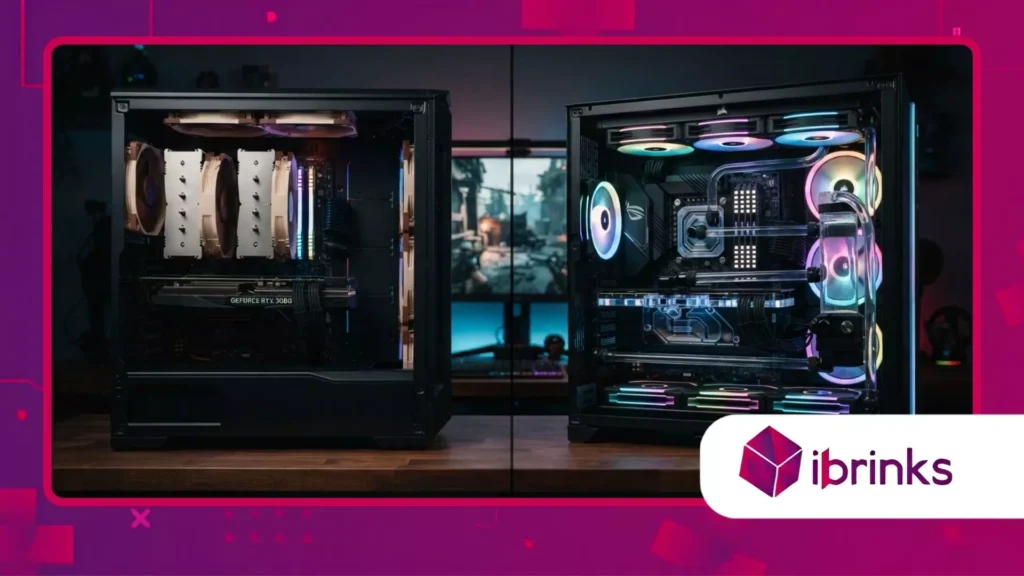
Traditionnel à base d'air solutions de refroidissement Ils utilisent des tours à ailettes massives en aluminium combinées à des caloducs en cuivre qui touchent directement le dissipateur thermique intégré au processeur.
La chaleur se transmet par conduction dans les tuyaux, puis remonte vers l'empilement d'ailettes où des ventilateurs à haut débit d'air évacuent l'énergie thermique.
Imaginez une tour à air comme un système de radiateur complexe sur une voiture de sport, utilisant des principes physiques simples et une grande surface pour dissiper efficacement la chaleur.
Cette conception éprouvée protège les processeurs de bureau depuis des décennies sans nécessiter de maintenance mécanique complexe ni risquer de fuites de liquide.
La simplicité demeure le principal atout des tours à air standard, offrant une fiabilité incroyable puisqu'elles ne présentent pratiquement aucun point de défaillance mécanique en dehors des roulements du ventilateur.
Si un ventilateur finit par s'user après des années de jeu intensif, son remplacement ne prend que quelques minutes et ne nécessite qu'un investissement financier minime.
De plus, les refroidisseurs à air haut de gamme rivalisent avec les systèmes de refroidissement liquide haut de gamme en termes de performances thermiques brutes, tout en limitant l'entretien global du système au simple dépoussiérage.
Ils assurent un refroidissement stable et fiable pour les utilisateurs qui privilégient une approche « paramétrable et sans intervention » en matière de gestion du matériel.
Pourquoi les passionnés choisissent-ils encore des tours à air massives ?
Les refroidisseurs d'air massifs à double tour offrent une capacité thermique exceptionnelle sans les risques inhérents associés aux pompes à liquide ou à l'évaporation du fluide au fil du temps.
Leur construction robuste garantit que même lors de longues sessions de rendu ou de jeux vidéo, les températures restent stables et prévisibles.
Cette fiabilité en fait un choix privilégié des constructeurs qui privilégient la stabilité absolue du système à l'esthétique.
++ Comment construire une chaîne audio silencieuse et sans latence
Quel est l'impact des courbes de ventilation sur les niveaux de bruit ?
La configuration précise des courbes de ventilation permet à votre système de rester pratiquement silencieux lors d'une navigation web légère, tout en augmentant progressivement sa vitesse lors de fortes charges de jeu.
Les ventilateurs PWM modernes utilisent des roulements hydrodynamiques avancés qui minimisent les vibrations et les bruits acoustiques désagréables, assurant ainsi un environnement de bureau agréable.
L'équilibre entre la pression du flux d'air et le niveau sonore est un art qui transforme un PC bruyant en une machine ultra-silencieuse.
Lire aussi : Comment optimiser la latence de la manette sur PC
Les refroidisseurs d'air peuvent-ils tenir dans des boîtiers compacts ?
La hauteur disponible représente la principale limitation lors du choix des tours d'aération, car les conceptions massives à double colonne entrent souvent en conflit avec les panneaux latéraux étroits ou les modules de mémoire hauts.
Les assembleurs doivent mesurer méticuleusement les dimensions du boîtier avant l'achat afin de s'assurer que la tour ne gêne pas les dissipateurs thermiques de la carte mère ni les emplacements de RAM.
Choisir des kits de RAM à profil bas résout les problèmes d'espace, permettant ainsi aux imposants refroidisseurs d'air de s'intégrer facilement dans les boîtiers de moyenne tour standard.
Que sont les refroidisseurs liquides et comment fonctionnent-ils ?
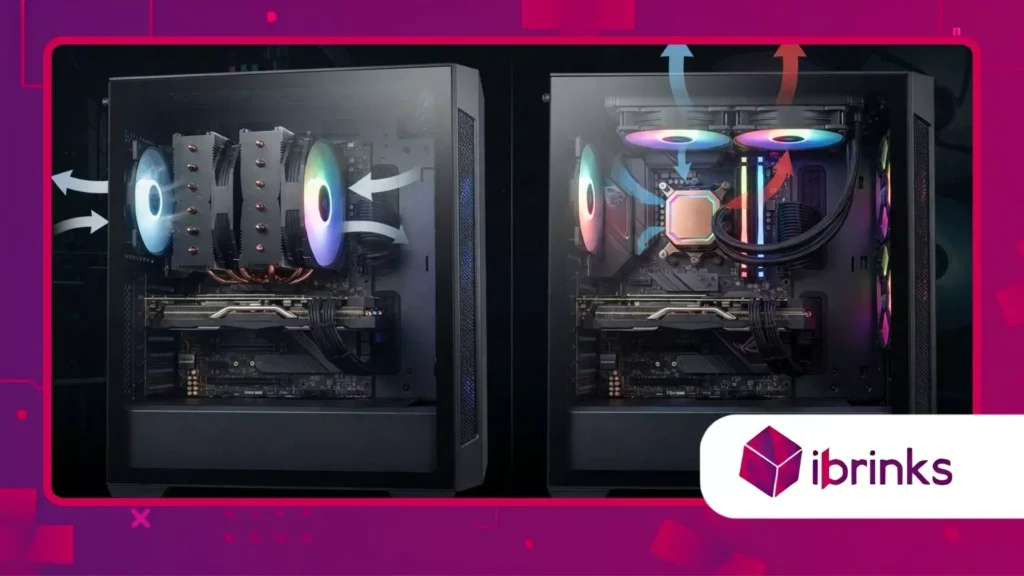
Liquide avancé solutions de refroidissement utiliser un bloc de pompe à circuit fermé, des tubes flexibles et un radiateur externe pour évacuer l'énergie thermique des composants en silicium délicats.
Le liquide de refroidissement absorbe la chaleur directement au niveau du bloc processeur, circule dans des tubes étanches et évacue la chaleur par des ventilateurs de radiateur montés sur le châssis.
Imaginez ce circuit fermé comme le système de refroidissement d'un moteur automobile, pompant efficacement le fluide à travers les zones chaudes pour maintenir des températures de fonctionnement optimales.
Cette conception permet d'évacuer la chaleur de la zone immédiate du socket, en la rejetant directement à l'extérieur du boîtier.
Les systèmes de refroidissement liquide tout-en-un à circuit fermé dominent les configurations haut de gamme modernes car ils offrent une esthétique épurée et un dégagement supérieur autour des modules de mémoire exigeants et des dissipateurs thermiques VRM.
Comme le radiateur est fixé directement sur le panneau supérieur ou avant du boîtier, le poids important est entièrement supprimé au niveau du socket du processeur de la carte mère.
Cette configuration offre une inertie thermique massive, absorbant les pics de température soudains lors de tâches de traitement brèves et intenses avant que la vitesse des ventilateurs n'augmente.
En savoir plus: Choisir le bon repose-pieds pour un confort de jeu optimal
Comment la fiabilité de la pompe influence-t-elle la durée de vie du système ?
Les pompes AIO modernes sont dotées de roulements en céramique et de moteurs sans balais conçus pour fonctionner en continu pendant des dizaines de milliers d'heures sans panne.
Cependant, la perméation microscopique de fluides à travers les tubes en caoutchouc se produit sur de nombreuses années, ce qui signifie que les unités à liquide scellées ont une durée de vie opérationnelle finie par rapport aux tours à air en métal solide.
La surveillance du régime de la pompe via le logiciel de la carte mère permet de détecter les premiers signes d'usure mécanique avant que la limitation thermique ne se produise.
Pourquoi le positionnement du radiateur est-il crucial pour les performances ?
Un montage correct du radiateur, idéalement avec les tubes en bas, ou en veillant à ce que le bloc pompe soit placé sous le haut du radiateur, empêche les bulles d'air emprisonnées de bloquer la circulation du liquide de refroidissement.
Les poches d'air à l'intérieur de la pompe créent des bourdonnements désagréables et réduisent considérablement l'efficacité du transfert thermique, ce qui entraîne une élévation des températures.
Un positionnement correct garantit un fonctionnement silencieux et maximise la durée de vie de l'ensemble du circuit de refroidissement liquide.
Les boucles de boucle personnalisées offrent-elles des performances supérieures ?
Les circuits de refroidissement liquide rigides sur mesure permettent d'atteindre le summum des performances thermiques en intégrant plusieurs radiateurs et en refroidissant simultanément le processeur et la carte graphique.
Bien que coûteuses et techniquement exigeantes à installer, les boucles de refroidissement personnalisées offrent un rendu visuel époustouflant et une marge de refroidissement inégalée pour les overclockeurs extrêmes.
Elles représentent le passe-temps ultime des passionnés de construction qui exigent à la fois des performances maximales et une esthétique sur mesure.
Comment les refroidisseurs à air et à liquide se comparent-ils dans des situations réelles ?
Choisir l'idéal solutions de refroidissement Votre flux de travail quotidien nécessite d'évaluer les performances de chaque technologie sous des charges de travail multicœurs soutenues et des températures ambiantes variables.
D'après des données de tests matériels récentes publiées par Gamers Nexus, les tours de refroidissement haut de gamme égalent les refroidisseurs liquides de 240 mm en termes de dissipation thermique soutenue tout en maintenant des niveaux de bruit de pointe plus faibles.
Cependant, les configurations liquides de 360 mm et 420 mm prennent l'avantage lors de charges de rendu extrêmes d'une heure en utilisant des surfaces massives pour dissiper immédiatement la chaleur à l'extérieur du châssis.
Comprendre ces courbes de performance vous aide à adapter votre achat de matériel à vos habitudes informatiques quotidiennes réelles.
Prenons cette analogie pratique : un refroidisseur d’air est comme porter une veste de sport respirante et légère qui compte sur le flux d’air naturel pendant un sprint, tandis qu’un refroidisseur à liquide agit comme un gilet de refroidissement à eau pompée utilisé par les pilotes de course professionnels.
Les deux systèmes permettent de maintenir l'athlète au frais, mais l'un repose sur un flux d'air ambiant direct tandis que l'autre utilise une circulation active de fluide pour gérer les températures extrêmes.
Choisir la bonne option garantit un fonctionnement optimal de votre système, sans dépenses financières inutiles ni complications liées à l'installation.
Comment la température ambiante influence-t-elle le choix ?
Les températures ambiantes élevées de l'été mettent à l'épreuve toutes les architectures thermiques, mais les refroidisseurs liquides gèrent souvent mieux les pics de chaleur soudains grâce à la capacité thermique massique élevée de l'eau.
Si votre salle de jeux n'est pas climatisée, un système de refroidissement liquide performant permet d'atténuer les fluctuations rapides de la température ambiante lors de sessions de jeu intenses.
Les refroidisseurs à air restent efficaces, mais dépendent fortement d'un flux d'air ambiant constant pour évacuer efficacement la chaleur du châssis.
Quel entretien est nécessaire au fil du temps ?
Les refroidisseurs d'air nécessitent un dépoussiérage occasionnel à l'air comprimé pour éviter que les ailettes ne soient obstruées par des poils d'animaux et des débris domestiques qui entravent la circulation de l'air.
Les systèmes de refroidissement liquide ne nécessitent pratiquement aucun entretien pendant leur période de garantie, bien que la vérification de l'accumulation de poussière sur les ailettes du radiateur haute densité reste essentielle pour des performances optimales.
Aucune de ces options ne nécessite un entretien important, ce qui rend la gestion thermique moderne remarquablement accessible aux utilisateurs occasionnels.
En quoi les complexités d'installation diffèrent-elles ?
L'installation d'un imposant refroidisseur d'air à double tour peut s'avérer délicate dans des espaces restreints, nécessitant souvent des tournevis magnétiques et de la patience pour dégager les modules de RAM.
À l'inverse, le montage d'un bloc de refroidissement liquide AIO sur le processeur est remarquablement rapide, bien que la fixation du radiateur volumineux et le passage soigné des tubes nécessitent une gestion minutieuse des câbles et des tubes.
Les deux méthodes nécessitent de suivre scrupuleusement les instructions du fabricant concernant le support afin de garantir une pression de montage correcte sur la puce en silicium.
Comparaison des performances thermiques et des spécifications matérielles
Le tableau comparatif ci-dessous présente les principales différences de fonctionnement entre les tours de refroidissement à air traditionnelles et les systèmes modernes à circuit fermé pour liquide.
| Indicateur de performance | Refroidisseurs d'air traditionnels | Refroidisseurs de liquide en circuit fermé |
| coût d'achat initial | Modéré à élevé (Meilleur rapport qualité-prix) | Prix plus élevé (Prix premium pour les articles esthétiques et en liquidation) |
| Risque mécanique | Extrêmement faible (Seules les pièces mobiles sont des ventilateurs standard) | Faible à modérée (Contient des pompes, des raccords et du liquide) |
| Dégagement de la douille | Limité par la hauteur des ailerons et du RAM | Excellent (le bloc pompe compact libère de l'espace dans la douille) |
| Tampon de masse thermique | Faible à modérée (Dépend du cuivre et de l'aluminium directs) | Élevé (le volume de liquide absorbe efficacement les pics soudains d'utilisation du processeur) |
| Profil acoustique | Généralement stable et silencieux sous charges standard | Pompe silencieuse, mais le bruit du ventilateur du radiateur augmente sous charge. |
Conclusion
Naviguer sur le marché pour une efficacité optimale solutions de refroidissement En fin de compte, tout se résume à trouver un équilibre entre vos préférences esthétiques, vos contraintes budgétaires et vos attentes en matière de performances pour votre configuration de jeu.
Que vous optiez pour la fiabilité à toute épreuve d'une imposante tour de refroidissement à air ou pour la conception élégante et haute capacité d'un refroidisseur liquide en circuit fermé, une gestion thermique adéquate protège votre précieux investissement matériel.
Prenez le temps d'évaluer les dimensions de votre boîtier et la charge de travail de votre processeur avant de prendre votre décision d'achat finale.
Quel système de refroidissement utilisez-vous actuellement pour votre PC de jeu principal, et quelles ont été ses performances en conditions réelles ? Partagez votre expérience dans les commentaires ci-dessous !
Questions fréquemment posées
Quelle solution de refroidissement a la plus longue durée de vie en moyenne ?
Les refroidisseurs d'air traditionnels ont généralement une durée de vie supérieure aux systèmes à liquide car ils ne comportent aucun composant fluide susceptible de s'évaporer ni de pompes pouvant tomber en panne mécaniquement avec le temps.
Une tour de refroidissement de qualité peut facilement supporter plusieurs cycles de mise à niveau du processeur sur une décennie, ne nécessitant qu'un simple remplacement du ventilateur si les roulements finissent par s'user.
Un système de refroidissement liquide bon marché peut-il être plus performant qu'un système de refroidissement à air coûteux ?
Les refroidisseurs liquides économiques de 120 mm sont souvent moins performants que les refroidisseurs à air à double tour de milieu ou haut de gamme en raison de la petite surface de leur radiateur et de la conception de leur pompe d'entrée de gamme.
Pour constater de réels gains de performance par rapport à un refroidissement par air de qualité, il est généralement nécessaire d'investir dans un système de refroidissement liquide avec radiateur de 240 mm ou plus.
Le choix de mon système de refroidissement aura-t-il une incidence sur la fréquence d'horloge automatique de mon processeur ?
Oui, les processeurs modernes intègrent des algorithmes de suralimentation dynamique qui augmentent la fréquence d'horloge tant que la marge thermique le permet.
Efficace solutions de refroidissement Maintenez les températures bien en dessous des seuils de limitation de fréquence, permettant ainsi à votre processeur de maintenir des fréquences d'accélération maximales plus longtemps lors de sessions de jeu ou de rendu intensives.
