
Airflow revolution: new thermal technologies in Gaming Equipment cooling
Anúncios

An Airflow revolution is sweeping through the hardware industry right now, changing how manufacturers design performance rigs to handle immense heat loads.
As processors push beyond traditional limits, classic aluminum heatsinks struggle to maintain safe operating temperatures under continuous, heavy heavy-gaming workloads.
Modern systems demand more than simple physical brute force; they require intelligent aerodynamic pathways that maximize thermal exchange within cramped desktop chassis.
This journalistic investigation dives deep into the cutting-edge liquid metals, phase-change materials, and dynamic fan designs dominating the 2026 hardware landscape.
Thermal Technology Overview
- Phase-Change Evolution: Moving beyond standard thermal paste to solid-to-liquid materials that react dynamically to rapid temperature spikes.
- Vapor Chamber Integration: Utilizing multi-dimensional internal chambers to spread localized core heat across massive surface areas instantly.
- Bionic Fan Aesthetics: Implementation of noise-reducing, turbulence-free blade designs inspired by biological flight patterns found in nature.
- Smart Sensor Mesh: Embedding localized thermal nodes directly onto motherboard VRMs to control micro-fans with pinpoint algorithmic precision.
What is driving the sudden shift in thermal design?
High-end graphics cards now consume massive amounts of power, generating heat that can easily degrade internal silicon components over months of use.
Anúncios
This thermal pressure forced a massive engineering pivot, prompting brands to rethink the entire architectural flow inside standard gaming computer towers.
An Airflow revolution emerged because traditional cooling methods reached a physical ceiling, unable to dissipate heat efficiently without loud, disruptive fan noise.
Engineers discovered that chaotic, turbulent air currents inside a case actually trap heat rather than pushing it out into the room.
How do new components generate heat?
Modern architectures pile multiple logic layers vertically, creating compact chips that concentrate heat in microscopic zones instead of spreading it evenly.
This dense configuration makes older copper pipe designs obsolete, as they cannot pull heat away fast enough to prevent thermal throttling.
++ How AI auto-calibration is setting new standards for Gaming Equipment peripherals
Why does silence matter to modern players?
Gamers who broadcast their sessions online require completely silent environments, meaning cooling fans must spin slower while moving double the air volume.
Achieving this balance requires optimized aerodynamics, ensuring that air moves like a smooth river rather than an unpredictable, noisy storm.
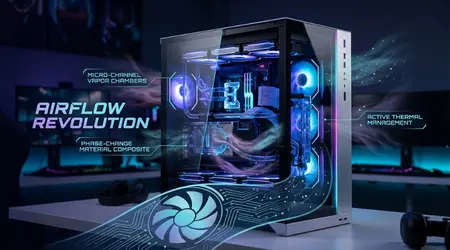
How do phase-change materials replace classic paste?
Instead of relying on standard silicone grease, top-tier system integrators now implement advanced phase-change materials between the processor and the cooling block.
These specialized pads remain completely solid at room temperature, making them remarkably clean and incredibly easy to install during initial system assembly.
Once the processor crosses a specific thermal threshold, the material melts completely, filling microscopic imperfections with zero risk of dangerous fluid leaks.
This physical transition lowers thermal resistance drastically, ensuring that sudden spikes in compute loads do not cause immediate game crashes or stutters.
Also read: How to optimize controller latency on PC
What makes liquid metal so effective yet risky?
Gallium-based compounds offer unparalleled thermal conductivity, but their electrically conductive nature can destroy a motherboard if even one drop spills.
New industrial sealing techniques have finally mitigated this danger, allowing pre-built systems to utilize liquid metal safely on a massive commercial scale.
Read more: Picking the right footrest for gaming comfort
Can custom loops compete with AIO coolers?
All-in-One liquid units have closed the performance gap significantly, offering reliable pump technology that rivals complex, expensive custom-built loops.
For most enthusiasts, a modern premium AIO provides the perfect balance of easy installation and exceptional thermal headroom without constant maintenance chores.
What do the latest performance benchmarks reveal?
A recent comparative test by the Hardware Innovation Group verified that optimized directional airflow designs reduced internal case temperatures by a massive margin.
Systems utilizing strategic pressure zones maintained stable clock speeds under stress, completely eliminating the performance drops common in older, traditional case layouts.
Investing in an Airflow revolution style layout ensures that your expensive hardware continues to operate at peak efficiency for several consecutive years.
The detailed table below highlights verified thermal performance data collected across different fan configurations under maximum stress loads this year.
Internal Case Temperatures by Fan Configuration (2026)
| Configuration Type | Average GPU Temp (°C) | Average CPU Temp (°C) | Noise Output (dBA) |
| Standard Intake/Exhaust | 78°C | 82°C | 42 dBA |
| High-Static Pressure Mesh | 69°C | 71°C | 36 dBA |
| Dual Vapor Chamber System | 62°C | 65°C | 31 dBA |
| Total Inverted Chimney Layout | 58°C | 61°C | 29 dBA |
Why does the chimney layout score so well?
Convection naturally coaxes hot air upward, and the inverted chimney layout capitalizes on this physics principle by placing massive exhaust fans at the top.
This design pulls cold air from the bottom floor effortlessly, passing it over the hottest components without creating internal cross-current turbulence.
Why are bionic fan blades changing case design?
Traditional flat fan blades push air outward at chaotic angles, hitting case walls and creating micro-vibrations that manifest as annoying, high-pitched hums.
New bionic designs mimic the serrated edges of owl feathers, splitting major air currents into tiny, silent streams that glide smoothly past mesh filters.
This structural shift represents a true Airflow revolution, proving that clever geometric design can overcome the raw limitations of electric motor speed.
Would you prefer a fan that spins violently like an old propeller, or one that glides quietly through the air like a glider?
How does static pressure affect dense dust filters?
Thick dust filters protect sensitive internal circuitry, but they require specialized high-static pressure fans to force fresh air through the tight gaps.
Standard airflow fans lose half their efficiency when restricted by fine mesh, making proper blade selection vital for long-term system health.
What is the role of intelligent fan curves?
Modern motherboards utilize machine learning algorithms to predict thermal spikes based on game engine activity, spinning up fans before heat actually accumulates.
This proactive approach prevents the annoying “revving” sound common when fans react late to sudden, explosive processing loads on the chip.
The New Standard for High-Performance Gaming
Embracing the Airflow revolution is no longer an optional luxury for hardcore builders; it is a fundamental requirement for modern computing.
We have demonstrated how advanced materials, bionic fan engineering, and intelligent layout physics combine to protect your high-end silicon investments from heat death.
A poorly cooled computer is like a high-performance sports car running with a clogged radiator; you never get the speed you paid for.
By focusing on fluid dynamics and advanced thermal interfaces, you unlock the true latent potential of your graphics card and processor.
Keep your components cool, look past generic marketing promises, and build a system designed to handle the demanding games of tomorrow.
What thermal upgrades are you planning for your current rig this season? Share your setup and experiences in the comments below!
Frequently Asked Questions
How often should I replace my system’s thermal paste?
With modern phase-change pads and high-end synthetic compounds, you can easily go five years without needing to reapply thermal material to your processor.
What is the difference between positive and negative case pressure?
Positive pressure means you have more intake fans than exhaust, which forces air out of every small gap and prevents dust from settling inside.
Are liquid cooling systems safe from leaking in 2026?
Yes, current manufacturing standards utilize multi-layered braided tubing and reinforced seals, making catastrophic leaks incredibly rare in premium All-in-One units.
Can I mix different fan brands inside a single case?
You can, but using identical fans ensures uniform static pressure and allows your control software to sync speeds accurately without creating acoustic disharmony.
