
How Photogrammetry Is Changing the Way Game Worlds Are Built
Anúncios
Photogrammetry has fundamentally transformed modern video game development, enabling art teams to capture physical real-world assets and convert them directly into ultra-realistic 3D digital environments.
By analyzing overlapping photographic imagery through specialized reconstruction software, spatial artists translate concrete textures, complex geological formations, and architectural ruins into high-density polygon models with unparalleled surface fidelity.
This advanced scanning methodology dramatically reduces manual sculpting timelines for environmental artists while elevating visual realism to cinematic standards across interactive platforms.
What to Expect in This Guide
- What Is Digital Surface Scanning in Modern Gaming?
- How Does Spatial Reconstruction Turn Photos into 3D Worlds?
- Why Are Triple-A Studios Ditching Manual Sculpting?
- What Real-World Data Proves Its Efficiency Improvements?
- How Do Game Engines Process High-Density Scanned Data?
- How Do Virtualized Geometry Systems Render Billions of Polygons?
- Where Does Texture Alignment Excel in Open-World Design?
- Why Is Scale Precision Essential for Immersion?
- What Are the Technical Limits and Future Frontiers of Scanned Assets?
- How Are Developers Overcoming Reflective Surface Scanning Challenges?
- What Role Will Dynamic Lighting Play in Next-Gen Capture Pipelines?
- How Does Machine Learning Enhance Detail Retrieval?
- Production Comparison: Manual Modeling vs. Photographic Scanning
- The Future Horizon of Virtual World Construction
- Frequently Asked Questions
What Is Digital Surface Scanning in Modern Gaming?
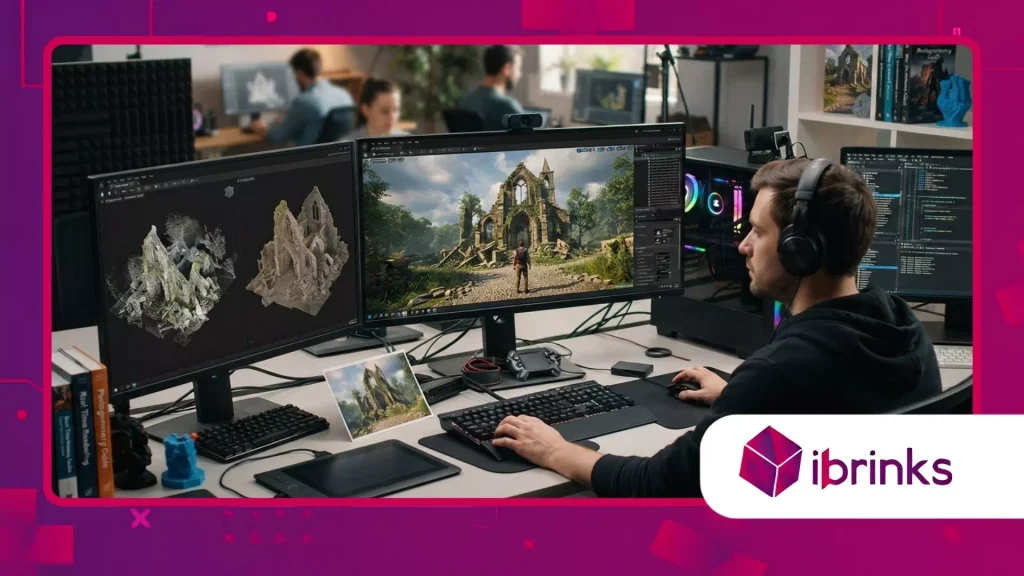
How Does Spatial Reconstruction Turn Photos into 3D Worlds?
The core physics of surface digitizing rely on capturing identical surface points across hundreds of overlapping photographs taken from distinct angles.
Software algorithms evaluate spatial shifts, triangulation values, and parallax variations between images to calculate precise point-cloud positions within a coordinate space.
Anúncios
Modern game developers utilize photogrammetry to convert these vast cloud arrays into continuous polygonal meshes, preserving organic imperfections that human artists rarely replicate manually.
Every mossy rock surface, weather-worn brick wall, and fractured cliff face retains its authentic tactile depth throughout the rendering pipeline.
This automated geometry generation completely bypasses traditional high-poly base modeling, allowing environment artists to focus immediately on optimization and scene placement.
Rather than spending weeks carefully modeling organic terrain structures, teams deploy field photographers to capture hundreds of raw source photos in real-world environments.
The resulting high-resolution assets integrate seamlessly into modern graphics engines, establishing realistic environmental foundations for narrative-driven titles.
Why Are Triple-A Studios Ditching Manual Sculpting?
Traditional manual 3D modeling demands extensive artistic hours to produce high-density meshes using digital sculpting tools.
While skilled creators craft remarkable environments, human hands naturally introduce subtle artistic uniformities that signal artificiality to the human eye.
Scanning real-world structures bypasses these repetitive stylistic habits by preserving non-uniform degradation, organic erosion, and unique material decay.
Consequently, major game studios achieve unprecedented visual authenticity while dramatically lowering production hours on asset creation.
By shifting labor hours from baseline geometry construction to environment assembly, art directors maintain tighter control over narrative pacing and level layout.
Production cycles shift focus toward atmosphere, environmental storytelling, and gameplay flow rather than basic asset sculpting.
This structural workflow adjustment gives smaller teams the capability to output graphical fidelity that previously required massive art departments.
++ The future of shared-world games beyond the MMO formula
What Real-World Data Proves Its Efficiency Improvements?
When Epic Games developed environmental assets for modern real-time engine demos, production records demonstrated dramatic workflow savings using high-definition scanning.
Industry research conducted by Epic Games revealed that leveraging scanned asset libraries reduced environment art production timelines by up to 150 percent compared to conventional manual creation workflows.
Isn’t it incredible how capturing physical reality directly frees creative teams to focus entirely on interactive world design?
This measurable efficiency gain directly impacts project timelines, allowing development studios to construct vast open-world maps without scaling team sizes exponentially.
Environmental fidelity no longer requires compromise against tight release schedules or restricted development budgets.
The resulting pipeline stabilization has firmly established digitized scanning as a non-negotiable industry standard.
How Do Game Engines Process High-Density Scanned Data?
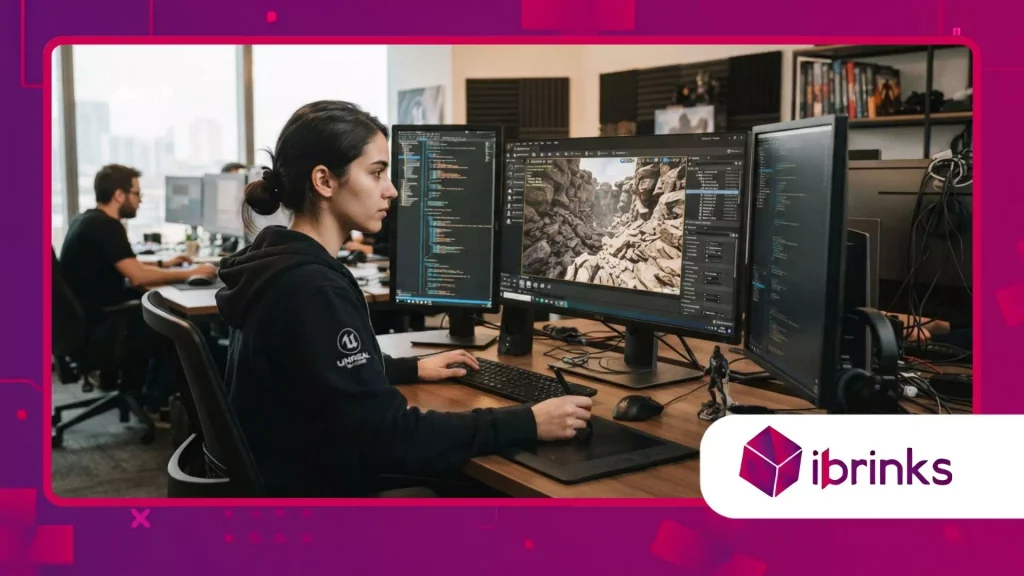
How Do Virtualized Geometry Systems Render Billions of Polygons?
Raw scanned environments frequently yield polygon counts reaching into dozens of millions for individual rock formations or tree trunks.
Historically, game engines required aggressive manual reduction and normal-map generation to make these heavy assets playable in real time.
Modern game engines resolve this bottleneck through real-time virtualized geometry micro-polygon systems that render geometry directly at pixel scale without requiring tedious manual baking.
This architectural shift allows games to stream raw source scans directly into active memory without visible level-of-detail pops.
Systems evaluate camera proximity continuously, drawing exact surface detail where visible while reducing polygon density for distant structures invisibly.
As a result, virtual environments maintain cinematic realism during rapid camera movements and seamless gameplay exploration.
Also read: The rise of community-driven roadmaps replacing fixed development plans
Where Does Texture Alignment Excel in Open-World Design?
Environmental immersion vanishes instantly when recurring ground textures display visible tiling patterns across vast game spaces.
Surface scanning resolves texture repetition by extracting complete material maps including diffuse color, roughness, and surface height from real-world grounds.
Developers tile these authentic material channels across vast terrain topographies using procedural blending masks, eliminating visible repeat lines entirely.
Furthermore, authentic light-interaction data derived through multi-angle photography yields exceptionally realistic surface response.
Metallic sheen, damp stone absorption, and dry dirt scattering react realistically under dynamic engine lights.
Games utilizing these material pipelines achieve consistent visual coherence regardless of changing weather presets or time-of-day cycles.
Read more: How modern games balance freedom vs guidance without hand-holding
Why Is Scale Precision Essential for Immersion?
Virtual spatial accuracy dictates how naturally a player perceives character movement within digital architecture.
When environmental proportions deviate slightly from real-world physics, player navigation feels floaty, unnatural, or constrained.
High-fidelity spatial scanning preserves exact real-world dimensions down to millimeter tolerances, delivering authentic human-scale proportions across interactive buildings and terrain.
This geometric precision proves invaluable when building interactive historical recreations or real-world urban locations.
Architectural structures match their physical counterparts exactly, allowing players to navigate recognizable real-world spaces with realistic spatial awareness.
Precise proportions enhance physical immersion while maintaining consistent collision physics across complex structural geometry.
What Are the Technical Limits and Future Frontiers of Scanned Assets?
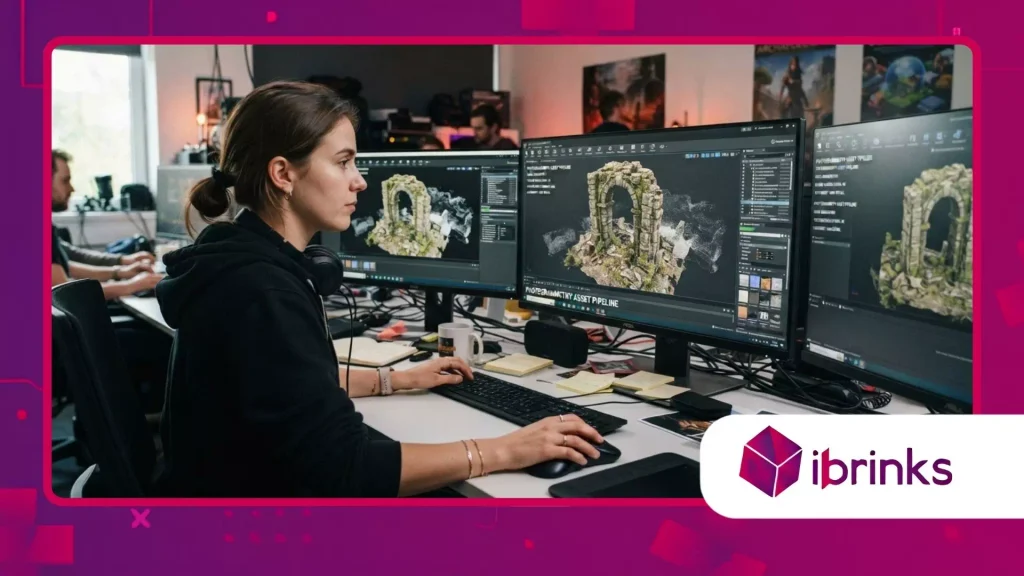
How Are Developers Overcoming Reflective Surface Scanning Challenges?
Despite its remarkable strengths, direct surface capture encounters severe physical hurdles when interacting with highly reflective, transparent, or uniform materials.
Water, polished metals, glass, and featureless monolithic walls confuse feature-matching algorithms, generating distorted point clouds or outright structural failures.
Scanning crews mitigate these lighting artifacts by applying temporary anti-glare sprays or capturing imagery under overcast light conditions.
Additionally, studio artists utilize specialized polarized camera filters to cross-polarize incoming light rays during capture sessions.
This technique strips specular reflections directly from raw source photographs, isolating pure albedo color values for engine illumination.
The resulting clean material maps ensure that digital objects react accurately under custom dynamic engine lighting setups.
What Role Will Dynamic Lighting Play in Next-Gen Capture Pipelines?
Legacy scanned assets often contain baked real-world shadows inside their color maps, creating visual errors when placed in dynamic virtual environments.
Modern capture pipelines deploy deliberate delighting algorithms that strip directional sunlight and soft shadows from raw photos automatically.
This process isolates neutral surface color, allowing dynamic in-engine sun positions to cast clean, accurate real-time shadows.
With raw surface colors fully isolated, digital environments adapt seamlessly to real-time day-night transitions and dynamic weather systems.
A scanned forest boulder reflects harsh midday sunlight or soft twilight hue with absolute physical accuracy. This lighting flexibility bridges the gap between static photographic assets and reactive virtual worlds.
How Does Machine Learning Enhance Detail Retrieval?
Artificial intelligence systems are rapidly refining raw spatial capture pipelines by reconstructing missing surface details automatically.
Machine learning models analyze incomplete photo arrays, filling point-cloud gaps caused by occluded angles or extreme shadows.
This automated compensation reduces necessary field photographs per object while significantly improving final mesh cleanliness.
Beyond geometric repair, neural networks assist in generating procedural tileable textures from single localized surface scans.
AI algorithms evaluate real-world wear patterns, extending unique material details across arbitrary terrain surfaces without introducing visual artifacts.
Integrating neural automation into asset pipelines accelerates environment development even further.
Production Comparison: Manual Modeling vs. Photographic Scanning
| Metric / Aspect | Traditional Manual Modeling | Advanced Photogrammetry Pipeline |
| Asset Creation Time | High (Days or weeks per high-detail asset) | Low (Hours for capture, process, and clean) |
| Surface Authenticity | Dependent on artist skill; prone to uniform look | Hyper-realistic; captures natural organic wear |
| Geometric Precision | Sculpted manually; scaled by eye | Sub-millimeter real-world spatial accuracy |
| Production Scalability | Requires large art departments to scale | Highly scalable with automated point processing |
| Resource Bottlenecks | Time-intensive manual high-poly sculpting | Processing power and specular reflection removal |
The Next Era of Virtual World Construction
Spatial digitization has permanently redefined the boundaries of environmental design across interactive entertainment media.
By bridging real-world physical structures with virtual real-time graphics engines, development teams craft breathtakingly authentic worlds with unprecedented production speed.
As automated delighting tools, neural surface completion, and virtualized geometry rendering continue to mature, the barrier between physical realities and interactive digital realms will dissolve completely.
Creative directors no longer struggle against asset creation constraints, opening endless opportunities for rich, immersive gameplay storytelling.
What incredible physical location will game developers capture and bring to life next? Share your thoughts and favorite photorealistic game worlds in the comments below!
Frequently Asked Questions
What is the primary difference between photogrammetry and 3D laser scanning?
Photogrammetry calculates 3D geometry using overlapping high-resolution photographs, capturing both high-detail surface textures and structural shape simultaneously through color matching algorithms.
In contrast, 3D laser scanning uses physical light pulses to measure exact distance coordinates, producing precise spatial geometry but requiring secondary photographic passes to capture surface color maps.
Can indie developers use surface scanning on lower production budgets?
Yes, indie game developers can readily implement surface capture workflows using standard consumer cameras or modern smartphone applications paired with open-source processing software.
While big studios utilize multi-camera arrays, small teams routinely capture professional-grade rock, ground, and tree assets using basic handheld camera hardware and accessible photogrammetric software pipelines.
Why do scanned assets sometimes look incorrect under game lighting?
Scanned assets appear visually off when real-world directional shadows or specular highlights remain baked into their diffuse color maps during photography.
If these baked shadows are not removed through delighting algorithms, they conflict with real-time in-engine sun sources, creating contradictory lighting cues that break visual immersion.
Is surface scanning limited strictly to static environmental objects?
While environmental props like cliffs, buildings, and ground materials represent the most common applications, scanning pipelines are also widely used to capture human faces, clothing folds, and complex props.
Specialized multi-camera rigs capture actor facial expressions instantaneously, generating hyper-realistic digital doubles for cinematic narrative sequences.
How does virtualized geometry help engines process massive scanned models?
Virtualized geometry systems stream high-density scanned assets dynamically by adjusting polygon rendering density based on camera distance and pixel resolution.
Instead of requiring artists to manually create reduced level-of-detail models, the engine streams only the exact geometric detail required per pixel, maintaining smooth real-time performance without visual fidelity loss.
