
Behind the Scenes of a Hybrid Gaming Championship: From Online to On-Stage
Anúncios

The modern esports landscape, especially in 2025, is defined by the sophisticated challenge of blending the digital with the physical.
Diving Behind the Scenes of a Hybrid Gaming Championship reveals an astonishing logistical ballet, one where top-tier competition seamlessly shifts from global online qualifiers to a spectacular, live, on-stage final.
This hybrid model part digital tournament, part physical spectacle has become the gold standard, maximizing global reach while preserving the electrifying energy of an arena event.
Successfully executing a hybrid event is a complex feat of technological integration, requiring flawless coordination across continents, often involving thousands of competitors.
This dual structure ensures competitive integrity during the early stages and delivers an unforgettable emotional payoff for the grand finale.
Anúncios
The true brilliance lies in the invisible infrastructure that bridges the gap, allowing a unified, high-quality viewer experience.
What are the Core Phases of a Hybrid Championship?
A hybrid tournament follows a distinct structure, meticulously designed to filter thousands of participants down to a handful of elite finalists.
The Digital Gauntlet: Ensuring Competitive Integrity Online
The initial phase involves massive open qualifiers conducted entirely online, allowing global participation and unprecedented accessibility. This truly open format is critical for grassroots development and finding undiscovered talent.
The fundamental challenge here is managing latency and server stability for players scattered across different geographic regions and time zones.
Tournament organizers utilize regional dedicated servers and strict network monitoring to minimize competitive disadvantage.
This remote phase generates substantial viewing hours, feeding interest into the later, more exclusive stages. Viewers appreciate the raw, unedited glimpse of emerging superstars in this first stage of a tournament.
++ Gamers’ Brainwaves on Display: How Neurotech Is Entering the Gaming Championship Arena
The Transition: Logistics of the Live Qualification
After the initial online rounds, the field narrows significantly, and the most crucial logistical phase begins: transitioning the top players to the live stage. This often involves flying competitors, coaches, and staff from dozens of different countries.
Organizers manage visas, accommodation, practice facilities, and travel schedules, treating professional gamers like traditional sports athletes.
The player experience during this transition directly impacts performance and the perception of the league’s professionalism.
The process of moving the competition from thousands of home setups to a centralized, controlled environment guarantees competitive fairness for the final matchups. This essential step is vital to the credibility of any major competition.
How Does Technical Production Bridge the Gap?
The production pipeline for a hybrid event must be resilient enough to handle both remote and in-person feeds without skipping a beat.
Why is the Centralized Production Hub Essential?
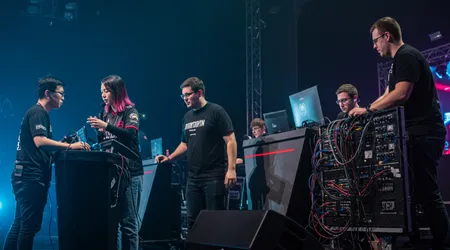
Modern hybrid events operate from a centralized broadcast facility, often far removed from the physical event stage, integrating feeds from multiple sources globally.
Also read: Esports Championship Stories: Behind the Scenes of Esports
The Magic of Remote Commentary and Multilingual Feeds
Commentary and analysis studios are frequently located in different countries, sometimes on different continents, from where the game is being played.
This remote production model allows for specialized, multilingual coverage (e.g., English, Spanish, and Mandarin broadcasts running simultaneously).
The hub must ingest, process, and output dozens of video and audio streams in real-time. This sophisticated orchestration ensures every regional audience receives a localized, high-quality broadcast.
This distributed workflow maximizes the talent pool of casters and analysts while reducing the immense travel overhead, proving the economic efficiency Behind the Scenes of a Hybrid Gaming Championship.
Read more: Valorant Champions 2025: Highlights and Surprises from Paris
The Critical Role of Ultra-Low Latency
In the final, on-stage rounds, all players compete on a dedicated Local Area Network (LAN). However, the real-time transmission of that gameplay to the global audience requires ultra-low latency broadcasting technology.
Viewers must see the action unfold virtually instantaneously, especially during crucial, split-second plays. Delays break the immersion and compromise the ‘live’ feel of the championship.
Organizing a hybrid championship is like conducting a global orchestra where some musicians are playing live on stage, and others are playing from their bedrooms, yet the conductor (the production team) must ensure the resulting music (the broadcast) is perfectly synchronized and pitch-perfect for millions.
What Unique Challenges Face a Hybrid Format?
The blend of digital and physical elements introduces a distinct set of logistical and integrity hurdles not found in purely online or purely LAN events.
How Do Organizers Maintain Competitive Fairness?
The primary challenge Behind the Scenes of a Hybrid Gaming Championship is ensuring parity when the playing field changes from decentralized home setups to centralized, controlled systems.
Standardizing Hardware and Software Environments
For the on-stage finals, every player must use identical, vetted equipment (monitors, PCs, peripherals) and have their software settings meticulously verified. This eliminates any hardware advantage gained from private sponsorship deals.
Furthermore, a dedicated team of tech staff wipes and reloads machine images between matches to prevent unauthorized software or configuration changes. This rigorous standardization is non-negotiable for competitive integrity.
Before the Grand Final of the Valorant Champions Tour regional event, a technician is observed using a custom diagnostic tool to verify that all 10 players’ mouse settings (DPI, polling rate) fall within the pre-approved range, ensuring no one is using a macro or unauthorized script.
The Risk of Human Error and Unforeseen Issues
Even with the most rigorous preparation, unexpected problems such as a power flicker, a network cable failure, or a peripheral malfunction can occur.
The quick, professional resolution of such issues, often unseen by viewers, is the mark of an experienced production team.
Tournament rules must clearly define protocols for pausing, restarting, or replaying matches due to technical failure.
Transparency and consistency in applying these rules are paramount to maintain competitor and fan trust. This high-stakes problem-solving is a major component of life Behind the Scenes of a Hybrid Gaming Championship.
The Viewer Experience and Market Impact
The shift to hybrid models has had a measurable positive impact on viewership and the overall growth of the esports market.
Why Has Hybridity Fueled Esports Growth in 2025?
The model has successfully balanced mass accessibility with the premium, high-production feel of a major live event, attracting both casual and dedicated viewers.
The global esports audience is projected to surpass 640 million viewers by the end of 2025, with this massive growth largely attributed to the hybrid model’s ability to engage both mobile-first and traditional PC/console audiences.
Maximizing Fan Engagement Through Live Attendance
The physical finals, even when the bulk of the tournament is online, provide an essential emotional anchor.
The roar of the live crowd is crucial for creating viral, unforgettable moments that drive viewership for the next event.
During the League of Legends World Championship final, the live audience’s collective, explosive cheer as the Nexus falls is instantly captured by directional microphones and injected into the global broadcast feed, making the remote viewer feel the intensity of the arena.
Technical and Logistical Complexity in Hybrid Events
| Aspect of Production | Primary Challenge | Solution in 2025 Hybrid Model |
| Competitive Integrity | Latency and hardware disparity in qualifiers | Mandatory regional dedicated servers; Vetted, identical LAN setups for finals. |
| Broadcast Delivery | Simultaneous, high-quality multilingual output | Centralized Production Control Room (PCR); Remote casters linked by fiber optic lines. |
| Player Management | International travel and practice parity | Chartered flights and pre-booked, private practice rooms (scrim facilities). |
| Technical Redundancy | Single points of failure (power, internet) | Multiple redundant power sources (UPS/Generators); Dual-path fiber internet connections. |
Conclusion: The New Blueprint for Competitive Gaming
The Behind the Scenes of a Hybrid Gaming Championship is a landscape of complex technology, rigorous protocol, and meticulous planning.
This model, perfected by the industry in 2025, represents the definitive blueprint for global competitive gaming.
It successfully balances the accessibility and scale of the digital world with the critical competitive integrity and emotional impact of a live stadium final.
The success hinges on the invisible synchronization of infrastructure, ensuring that the spectacle on stage is merely the polished tip of a massive, globally connected production iceberg.
Given the immense technical complexity of these global events, is the effort and cost of running a large-scale hybrid tournament truly worth the marginal viewership increase over a purely online format?
Tell us in the comments what element of the live spectacle you find most essential!
Frequently Asked Questions (FAQ)
Q: What is the biggest unexpected cost in a hybrid championship?
A: The largest unseen expense is often the internet and networking infrastructure. Securing dedicated, redundant, and guaranteed high-speed fiber lines for both the players (LAN) and the broadcast production is incredibly costly and complex globally.
Q: Do players prefer the hybrid format over purely LAN tournaments?
A: Most top professionals prefer the hybrid model. They appreciate the ability to qualify from their homes (less initial travel) but demand the strict competitive integrity and the adrenaline rush of the crowd that only the live LAN final can provide.
Q: How do organizers prevent cheating during the online qualification stages?
A: Organizers use increasingly sophisticated anti-cheat software, mandatory webcam monitoring during high-stakes matches, and AI-driven behavior analysis.
Any statistical anomalies are flagged for human review, proving that the integrity Behind the Scenes of a Hybrid Gaming Championship is constantly prioritized.
