
How automobile simulators recreate the pressure of real racing
Annonser
Automobile simulators have transformed competitive motorsport by forcing drivers to confront genuine psychological stress, rapid heart rates, and split-second decision-making under extreme digital conditions.
Modern competitive platforms in 2026 replicate the physical exhaustion of endurance racing through high-torque direct-drive wheelbases, hydraulic load-cell pedals, and laser-scanned circuits that punish every millimeter of driver error.
When you sit inside an advanced rig during a championship decider, your central nervous system reacts to virtual tire degradation and aggressive wheel-to-wheel battles just as it does on a physical asphalt track.
Virtual track environments no longer feel like casual entertainment because top-tier telemetry systems demand the exact same mental discipline required in professional cockpits.
In this deep dive into virtual motorsport pressure, we explore:
Annonser
- How physical hardware feedback triggers authentic adrenaline responses in sim drivers.
- Why real-time telemetry, dynamic weather, and tire thermal modeling create relentless mental fatigue.
- Which competitive ranking systems and championship formats mirror the high-stakes anxiety of real-world grids.
- A direct breakdown comparing physiological and technical stress triggers between physical race cars and modern racing rigs.
- Answers to the most common questions about competitive sim racing psychology and hardware preparation.
How Does Sim Racing Hardware Trigger Genuine Physiological Stress?
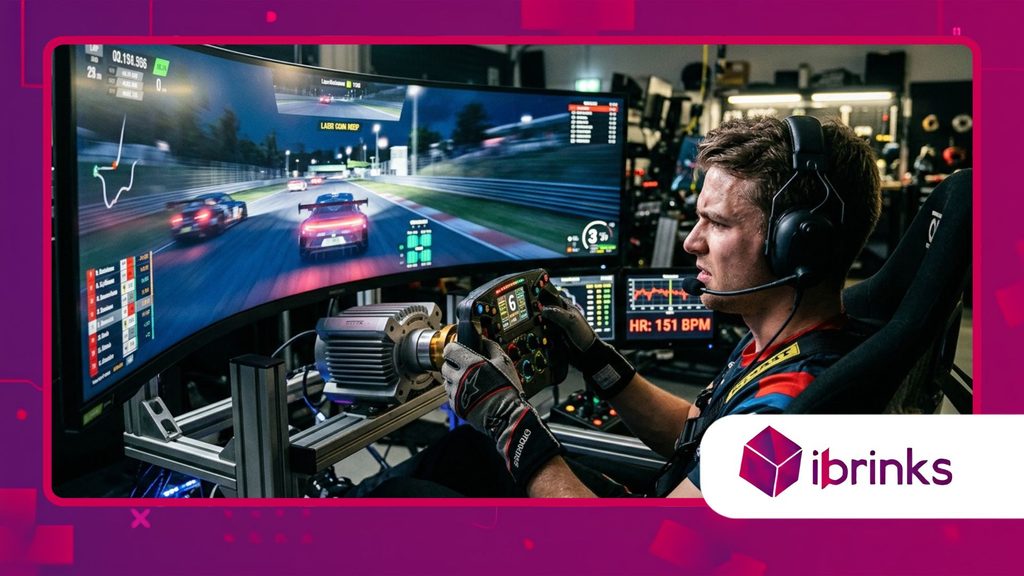
What Role Do Direct-Drive Wheelbases Play in Driver Fatigue?
High-torque direct-drive wheelbases deliver unfiltered steering forces that demand constant upper-body tension and sustained muscular endurance throughout long competitive stints.
Unlike older gear-driven controllers that masked road textures, modern servo motors transmit every curb strike, suspension compression, and sudden loss of rear traction directly into the driver’s wrists and forearms.
Fighting a 20-Newton-meter steering column through high-speed corners forces your muscles to stay locked in an isometric hold, which rapidly elevates core body temperature and mimics the physical strain of a real cockpit.
Drivers quickly realize that losing focus for a fraction of a second allows the wheel to snap violently, turning a minor oversteer moment into a race-ending crash.
Maintaining precise control over these heavy steering forces creates a continuous feedback loop between physical exertion and mental anxiety during the final laps of a sprint event.
As forearm muscles accumulate lactic acid, fine motor control begins to deteriorate, making smooth turn-in inputs noticeably harder to execute under braking.
Automobile simulators exploit this biological limitation by forcing competitors to manage physical exhaustion while simultaneously defending their track position against faster rivals.
Have you ever felt your hands trembling on the wheel during the final lap of an online championship race?
Why Do Load-Cell Pedals Replicate Real Braking Pressure?
Hydraulic and load-cell brake pedals require drivers to apply up to 100 kilograms of leg force, replacing forgiving positional sensors with muscle-memory pressure thresholds.
In real motorsport, stopping a race car from 280 kilometers per hour relies on threshold braking right before the tires lock up, a sensation governed entirely by foot pressure rather than pedal travel distance.
Modern sim racing pedals replicate this exact mechanical resistance using industrial elastomers and fluid dampers, compelling the driver to brace their entire lower body against the bucket seat during every heavy braking zone.
Pressing the pedal with too much force locks the front wheels and flat-spots the virtual rubber, ruining lap times for the remainder of the stint.
This constant demand for calibrated leg strength triggers a measurable spike in cortisol and adrenaline whenever two cars enter a braking zone side by side.
When you are defending the inside line into a tight hairpin, your brain must calculate braking distances while managing the physical strain in your left leg and resisting the urge to panic-brake too early.
According to sports science research conducted at the Porsche Human Performance Centre, professional sim racers regularly reach heart rates between 140 and 160 beats per minute during competitive esports events, closely mirroring the cardiovascular load experienced inside real GT3 race cars.
That intense cardiovascular output proves that high-resistance pedal hardware turns simple desk setups into genuine athletic testing grounds.
++ Hvordan rabatttidspunktet endres når spillere endelig kjøper spill på salg
How Do Motion Rigs and Spatial Audio Heighten Situational Awareness?
Multi-actuator motion platforms and binaural spatial audio surround the driver with immediate sensory cues that amplify the fear of making a costly mistake.
When a chassis actuator pitches forward under heavy braking or drops sharply over a blind crest, your inner ear registers genuine vestibular movement that tricks the brain into perceiving physical danger.
Simultaneously, specialized audio engines isolate the sound of scrubbing front tires, shifting gearbox teeth, and approaching rival exhausts, creating an immersive acoustic environment where every noise signals potential mechanical trouble or an imminent overtaking attempt.
Think of a modern racing rig like a commercial flight simulator used to train airline captains during catastrophic engine failures; the aircraft never leaves the ground, yet the pilot sweats through their shirt because every sensory input screams urgency.
By combining subtle chassis vibrations with directional wind simulators and peripheral visual cues, automobile simulators eliminate the psychological safety net of sitting safely inside a bedroom or training facility.
When your senses are completely saturated with realistic track data, your survival instincts take over, making every overtakes feel genuinely risky.
Which Software Mechanics Create Real-Time Competitive Pressure?
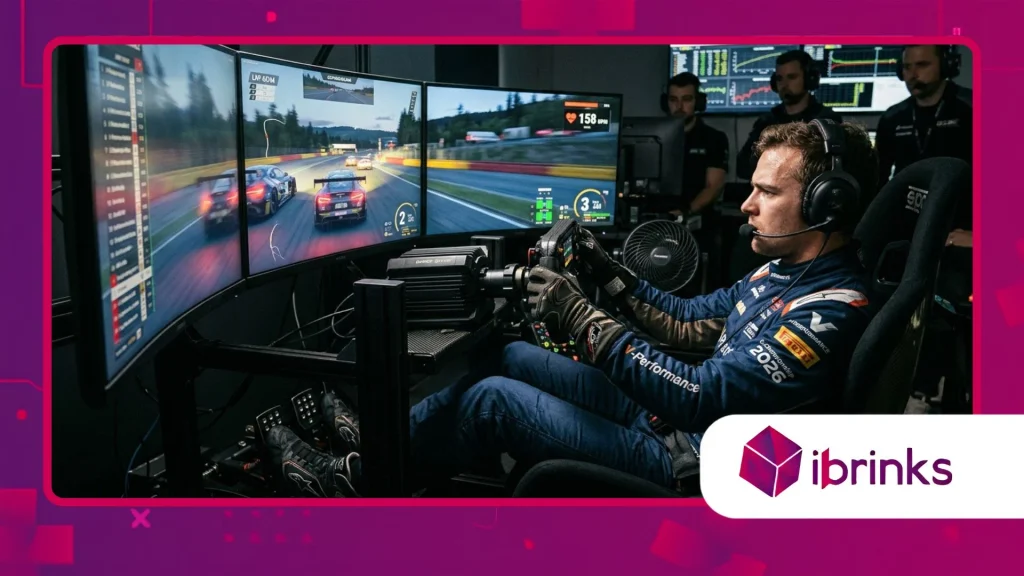
How Do Dynamic Track Evolution and Weather Systems Force Constant Adaptation?
Modern physics engines calculate real-time track rubbering, ambient temperature shifts, and localized rain showers that invalidate pre-race setups within minutes.
Instead of driving on a static digital surface with predictable grip levels, competitors in 2026 must read subtle visual changes on the asphalt, such as darkened racing lines or glistening wet patches under overcast skies.
A sudden drop in track temperature changes tire pressures and shifts aerodynamic balance, forcing drivers to adjust brake bias and differential settings on the fly while navigating traffic at full speed.
Adapting to unpredictable environmental variables prevents drivers from relying purely on memorized braking markers and mechanical muscle memory.
For example, during a virtual 24-hour endurance race on platforms like iRacing or Le Mans Ultimate, a driver taking over the night stint might encounter unexpected drizzle on the back straight while running slick tires.
Deciding whether to pit immediately for wet rubber or gamble on staying out for two more laps creates the exact same strategic panic experienced by real-world race engineers on the pit wall.
++ Hvordan uavhengige spill utfordrer storutgivelser
Why Does Advanced Tire Thermal Modeling Punish Aggressive Driving?
Granular tire physics simulate surface carcass temperatures, internal air pressure expansion, and structural graining whenever a driver slides the car excessively.
Pushing too hard during the opening laps overheats the rubber compound, causing grip levels to plummet and turning the car unpredictable through fast sweeping corners.
Drivers cannot simply drive at qualifying pace for an entire race distance; they must constantly monitor telemetry dashboards and modulate steering angles to keep tire temperatures inside a narrow optimal window.
Managing fragile virtual tires introduces a relentless psychological tug-of-war between raw speed and mechanical preservation. Consider a competitive sim racer leading a 45-minute GT race with a faster opponent sitting half a second behind their rear bumper.
If the leader overdrives the corners to break the slipstream, their front tires will overheat and lose grip within five laps, guaranteeing an easy pass for the rival later in the stint.
Automobile simulators use these unforgiving thermal equations to punish impatience and reward disciplined, calculated racecraft.
Les også: Hvorfor stilisert grafikk kan eldes bedre enn fotorealisme
How Do Damage Models and Fuel Strategy Eliminate Reckless Mistakes?
Full-scale mechanical damage systems and strict fuel consumption rules ensure that minor collisions or poor resource management permanently ruin a driver’s race.
Unlike arcade racing games where bouncing off barriers carries zero consequences, serious simulation titles bend suspension geometry, puncture radiators, and tear away aerodynamic dive planes upon contact.
Even a light tap against a concrete wall can misalign your steering wheel by ten degrees and rob the car of top speed down long straights, forcing an agonizingly slow trip back to the pit lane for lengthy repairs.
Fuel saving adds another layer of cognitive overload during tightly contested endurance events where pit stop windows determine the final podium order.
Drivers frequently have to lift off the throttle hundreds of meters before braking zones and shift early to hit target fuel numbers while still maintaining defensive lap times.
Performing mental arithmetic to calculate remaining fuel laps while fending off aggressive challengers pushes human cognitive capacity to its absolute limit.
Why Do Virtual Championships Mirror Real Motorsport Anxiety?
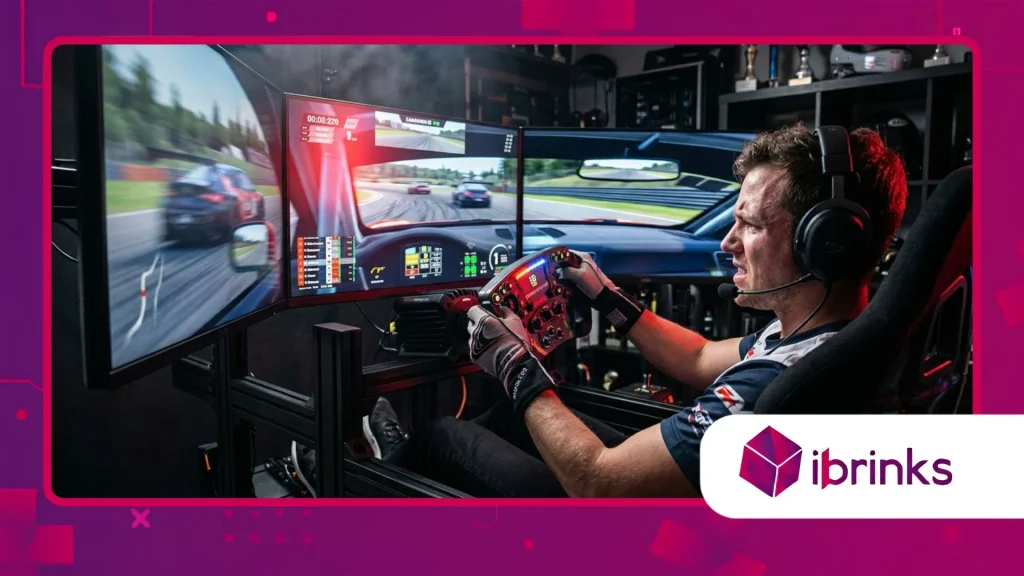
How Do Safety Ratings and Ranked Matchmaking Enforce Accountability?
Automated safety rating algorithms and skill-based matchmaking systems attach permanent statistical consequences to every single corner a driver completes online.
Platforms track off-track excursions, loss-of-control spins, and car-to-car contacts, deducting license points whenever a competitor drives recklessly.
Dropping below specific safety thresholds locks drivers out of premier series and special endurance events, creating a strong incentive to drive cleanly and respect track limits even during heated mid-pack battles.
Because your competitive reputation follows your profile across every session, starting in the middle of a 30-car grid triggers genuine pre-race nerves.
Everyone on the starting grid knows that an avoidable first-corner collision destroys hours of practice and tanks their hard-earned rating.
Automobile simulators rely on these strict behavioral ecosystems to replicate the financial and career consequences that keep real-world racing drivers disciplined under pressure.
What Makes Live Broadcast Esports Leagues Feel Like Physical Races?
Official esports championships sanctioned by organizations like the FIA, Formula 1, and SRO Motorsports Group place sim racers in front of live global audiences, commentators, and team principals.
Competitors race under strict sporting regulations, facing live stewarding panels that hand out drive-through penalties, time additions, and disqualifications in real time.
Knowing that thousands of spectators and real motorsport scouts are watching every braking zone transforms a digital race into a high-stakes professional audition.
A prime example occurred during recent virtual endurance championships where factory-backed sim teams competed for six-figure prize pools alongside real-world Formula 1 and GT drivers.
In the closing minutes of a 12-hour event at Sebring, a lead driver misjudged a lapped prototype by mere centimeters, triggering a live steward investigation and intense media scrutiny within seconds.
That level of public accountability ensures that virtual podiums carry authentic emotional weight, complete with genuine heartbreak in defeat and overwhelming relief at the checkered flag.
How Do Real Racing Teams Use Simulators to Test Driver Resilience?
Professional motorsport teams embed driver-in-the-loop simulators directly into their weekly race preparation to evaluate how drivers handle mechanical failures and strategic curveballs.
Race engineers intentionally inject sudden brake failures, radio communication dropouts, or unexpected safety car periods during training sessions to observe how a driver reacts under peak cognitive stress.
By measuring biometric data alongside steering and pedal inputs, teams identify whether a driver panics or maintains composure when everything goes wrong at once.
These intense engineering drills prove that top-level racing organizations treat virtual cockpits as legitimate psychological proving grounds rather than simple track-familiarization tools.
When a young academy driver steps into a team’s facility, their ability to stay calm during simulated qualifying traffic directly influences whether they earn a seat in a real race car.
Real Racing vs. Modern Automobile Simulators: Pressure Comparison
| Stress Factor | Real-World Motorsport | Modern Automobile Simulators (2026) |
| Physical Force | Sustained 3G to 5G cornering loads plus extreme cockpit heat. | Up to 25Nm steering torque, 100kg pedal force, and tactile motion cues. |
| Cardiovascular Load | Heart rates averaging 150–175 BPM during intense wheel-to-wheel stints. | Heart rates reaching 140–160 BPM during competitive championship races. |
| Consequences of Error | Severe physical injury risk and hundreds of thousands in chassis damage. | Permanent safety rating loss, esports disqualification, and ruined team strategy. |
| Environmental Variables | Real wind gusts, shifting track temperatures, and unpredictable rain showers. | Dynamic weather engines, live rubber buildup, and granular tire thermal wear. |
| Strategic Pressure | Live radio communication with race engineers and strict pit-wall fuel targets. | Real-time telemetry adjustments, multi-class traffic, and live stewarding penalties. |
The Future of High-Stakes Virtual Motorsport
Modern racing simulations have permanently erased the boundary between casual gaming and genuine athletic competition by attacking the human nervous system from every angle.
Through punishing direct-drive force feedback, unforgiving tire thermodynamics, and fiercely policed online rankings, virtual tracks demand complete emotional control and physical endurance.
Whether you are battling for a local league trophy or competing in an official manufacturer championship, automobile simulators force you to master your own adrenaline before you can ever master the circuit.
If you have ever experienced the heart-pounding tension of a final-lap battle on a racing rig, share your most memorable sim racing moment in the comments below.
Ofte stilte spørsmål
Can automobile simulators actually prepare drivers for real-world race cars?
Yes, professional racing teams and sanctioning bodies routinely use high-end simulators to train drivers on track layouts, braking references, and emergency procedures.
Famous graduates like Max Verstappen, William Byron, and Jann Mardenborough have publicly credited their simulator training with sharpening their spatial awareness, racecraft, and ability to stay calm during chaotic real-world starts.
Why do sim racers sweat so much if there are no real G-forces?
Sim racers sweat heavily because isometric muscle tension from fighting strong force-feedback wheels and heavy brake pedals generates substantial internal body heat.
Combined with high adrenaline levels, intense visual concentration, and closed-room environments without natural airflow, the human body triggers a strong cooling response identical to physical exercise.
Which sim racing hardware component creates the most realistic pressure?
A high-quality load-cell or hydraulic brake pedal set creates the biggest jump in realistic driving pressure.
Because braking consistency determines lap times and prevents lockups under stress, training your leg muscles to modulate heavy pressure builds authentic motorsport muscle memory far better than any visual upgrade.
How do professional esports drivers manage anxiety before major virtual races?
Top esports competitors use structured pre-race routines including controlled box breathing, hydration protocols, and mental visualization of opening-lap braking zones.
Many professional sim racing teams also employ sports psychologists to help drivers reset mentally after mid-race incidents or steward penalties.
Are modern racing simulators harder to drive than real cars?
In certain situations, simulators can actually feel slightly harder because drivers lack the inner-ear G-force sensations that naturally warn when a real car begins sliding.
Without physical seat-of-the-pants feedback, sim drivers must rely entirely on visual horizon shifts, audio tire cues, and steering wheel torque changes to catch sudden oversteer.
