
Exploring text‑adventure games before graphics”
Annúncios
Text-adventure games defined an era of interactive entertainment when computer graphics were nonexistent, relying entirely on vivid writing, parser engines, and player imagination to build immersive virtual worlds.
Long before modern photorealistic rendering pipelines took over digital entertainment, early computer enthusiasts typed text commands into terminal displays to explore dark caverns, navigate interstellar voyages, and solve complex environmental puzzles.
This deep dive into text-driven gaming explores how early developers created memorable narratives, why textual interaction remains remarkably engaging today, and how interactive fiction established the structural foundations for contemporary role-playing video games and narrative-driven titles.
Apa yang Anda Akan Temui dalam Panduan Ini
- What Are Text-Adventure Games and How Did They Work? Examining the core mechanics, terminal parsers, and command interfaces of early interactive fiction classics like Pengembaraan Gua Kolosal dan Zork.
- Why Did Early Storytellers Choose Text Over Graphics? Analyzing how memory restrictions, visual imagination, and spatial puzzle design created deeply engaging virtual environments without pixels.
- How Do Classic Text Adventures Influence Modern Game Design? Exploring the lasting legacy of parser design, choice-driven narrative engines, and branching dialogue systems in contemporary RPGs.
- Comparative Overview of Pioneer Text Adventures An informative breakdown of legendary text titles, release years, engine systems, and key gameplay features.
- The Continuing Legacy of Interactive Fiction A comprehensive evaluation of interactive fiction’s future, modern community engines, and modern retro gaming preservation.
- Soalan Lazim Answers to common questions regarding text adventure development, modern parsers, and historical milestones.
What Are Text-Adventure Games and How Did They Work?
How Did Early Terminal Parsers Process Player Commands?
Early mainframe computers lacked graphic cards, forcing developers to build interactive software using text input systems known as natural language command parsers.
Players typed simple verb-noun instructions such as “TAKE LAMP” or “GO NORTH” into a terminal prompt, which the game software evaluated against an internal dictionary of recognized actions and objects.
Annúncios
This conversational dynamic required players to read descriptive paragraphs, build mental maps of their surroundings, and experiment with syntax to manipulate interactive game environments successfully.
According to research documented by the Internet Archive’s Digital Software Preservation Project, early interactive fiction games contained parsers that managed over 600 unique vocabulary words, enabling thousands of contextual interaction combinations.
When a player entered an unrecognized command, the parser returned contextual error messages, subtly guiding the player toward valid actions within the world.
This textual feedback loop created a unique sense of partnership between human creativity and procedural logic, proving that narrative depth did not rely on visual hardware capabilities.
++ Bagaimana Mod Permainan Retro Mengekalkan Tajuk Klasik
Mengapa Adakah text-adventure Gameplay So Immersive Without Pixels?
Interactive narrative software engaged human imagination directly, allowing readers to visualize environments, characters, and hazards with infinite personal detail.
Rather than viewing predefined pixel graphics on low-resolution displays, players interpreted rich prose that described sensory details like echoing footsteps, damp stone walls, and flickering torchlight.
This literary approach transformed players from passive audience members into active co-authors of their digital journeys, deepening emotional investment in every decision made.
Yang text-adventure experience operated much like an interactive novel, where spatial navigation and inventory management required meticulous note-taking and manual mapping on graph paper.
Because computer memory was severely restricted during the late 1970s and early 1980s, game designers focused heavily on dialogue trees, atmospheric writing, and logical puzzle chains rather than visual presentation.
Consequently, players formed intense psychological connections with these unseen game worlds, demonstrating that words could evoke powerful presence and persistent atmosphere.
Why Did Early Storytellers Choose Text Over Graphics?
What Technical Constraints Shaped Interactive Fiction Development?
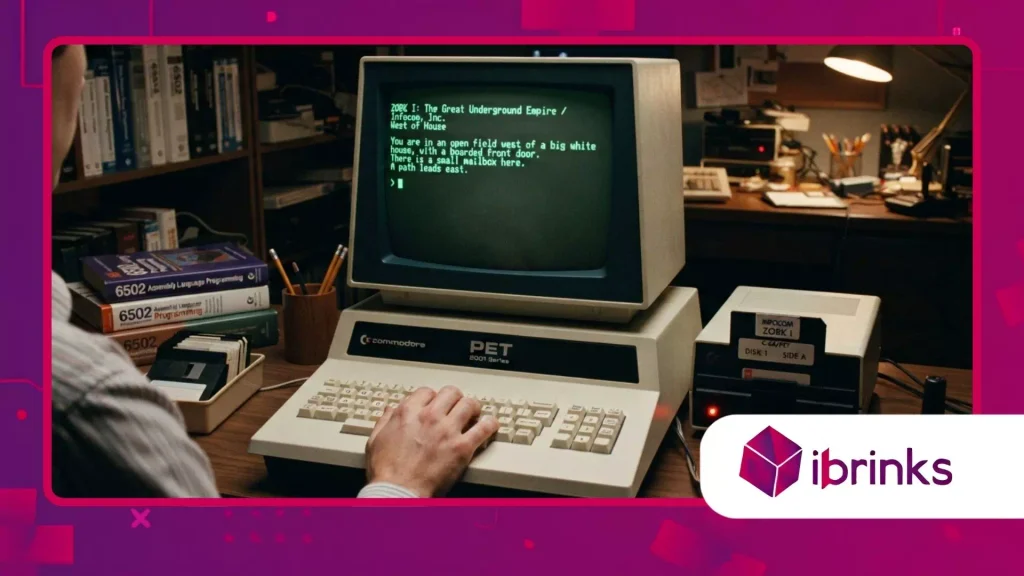
Early personal computers such as the Apple II, Commodore PET, and TRS-80 possessed limited RAM capacities, often constrained between 4 kilobytes and 48 kilobytes total.
Rendering high-resolution graphical scenes consumed vast amounts of memory and storage space, making pure textual descriptions the most efficient method for delivering sprawling game worlds.
By storing descriptions as ASCII text strings, interactive designers like Will Crowther and Infocom’s Marc Blank packed dozens of complex rooms, items, and Non-Player Characters into tiny floppy disk formats.
These severe hardware limitations forced programmers to innovate through efficient database structures and compressed text storage techniques rather than visual assets.
Infocom developed the famous Z-Machine interpreter, an early virtual machine concept that allowed text-heavy titles to run seamlessly across completely different hardware platforms.
This technical achievement allowed interactive writers to focus on crafting elaborate storylines, branching choices, and intricate mechanics without rewriting code bases for every competing computer model on the market.
Baca juga: Mengapa majalah permainan serantau membentuk komuniti pemain tempatan
How Did Spatial Puzzles Replace Visual Mechanics in Text Games?
Without graphic maps or visual health bars, early adventure software relied on spatial awareness, environmental inventory manipulation, and textual clues to challenge players.
A player might encounter a locked door in a subterranean complex, requiring them to explore adjacent chambers, examine hidden objects, and unlock hidden passages through precise phrasing.
This structural emphasis on logical deduction made text-adventure titles exceptionally intellectually satisfying, appealing to puzzle enthusiasts, university researchers, and avid readers alike.
Designing spatial puzzles in text demanded clear prose so players could deduce room layouts and logical object interactions without visual confusion.
Writers carefully placed subtle linguistic clues within room descriptions, prompting players to inspect specific items or attempt unusual actions to progress through locked areas.
This reliance on textual investigation established enduring game design conventions, teaching generations of players to analyze environmental details and think critically about narrative environments.
How Do Classic Text Adventures Influence Modern Game Design?
Why Do Modern RPGs Still Rely on Text-Driven Choice Systems?
Contemporary role-playing games and narrative titles directly inherit their branching storylines, dynamic dialogue choices, and moral consequence engines from early interactive text games.
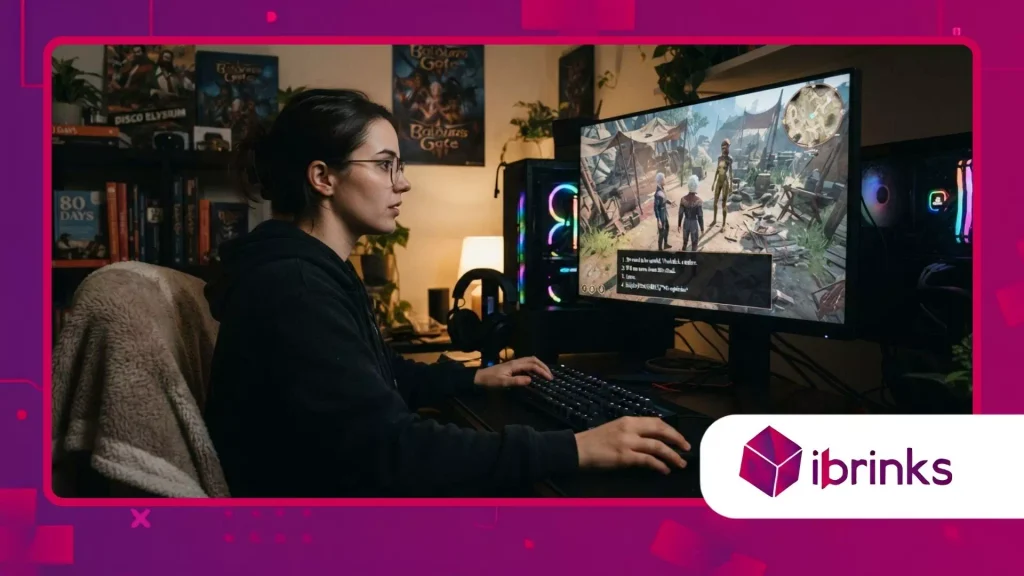
Tajuk moden seperti Disco Elysium, Pintu Baldur 3, dan 80 Days utilize expansive written scripts to give choices emotional weight and systemic consequences.
While modern releases feature cutting-edge graphic engines, their underlying mechanics rely on textual databases and complex state variables pioneered during the interactive fiction era.
The transition from text-only commands to graphical menus did not erase the core appeal of text-driven interactive storytelling in contemporary gaming culture.
Written dialogue options permit far greater narrative granularity and role-playing freedom than fully animated cutscenes, as writing new story branches requires fewer development resources than rendered animation.
As a result, game developers continue using written text as the primary medium for conveying complex choices, philosophical themes, and deep character interactions.
Baca lebih lanjut: Menganalisis kebangkitan remaster retro: pemasaran dan nostalgia
How Has the text-adventure Paradigm Evolved with AI and Modern Engines?
Modern independent game developers continue expanding interactive text traditions through contemporary software tools like Inform 7, Twine, and advanced machine learning models.
Contemporary tools allow creators to write interactive stories using natural English phrasing, automatically compiling complex logical rules and state tracking into clean web-accessible formats.
Furthermore, emerging generative AI systems use massive language models to generate infinite procedural text responses, building directly upon the foundational parser concepts invented decades ago.
Despite the dominance of photorealistic virtual reality and real-time graphics engines, the active interactive fiction community remains remarkably vibrant and creative today.
Developers host annual international competitions, releasing hundreds of innovative text titles that explore personal narratives, historical mysteries, and experimental storytelling mechanics.
The persistent vitality of interactive prose confirms that evocative writing and interactive agency remain powerful tools for digital entertainment across any era.
Comparative Overview of Pioneer Text Adventures
The following table summarizes landmark interactive text titles that established structural standards, parser innovations, and narrative benchmarks for the retro gaming industry.
| Tajuk Permainan | Tahun Keluaran | Primary Developer / Publisher | Technical Innovation | Fokus Permainan Teras |
| Pengembaraan Gua Kolosal | 1976 | Will Crowther & Don Woods | First two-word command parser | Subterranean exploration and cave mapping |
| Zork: The Great Underground Empire | 1977 | Tim Anderson, Marc Blank, Bruce Daniels, Dave Lebling (Infocom) | Advanced multi-word parser and dynamic object states | Treasure hunting, maze navigation, and world puzzles |
| Panduan Penumpang Menumpang ke Galaksi | 1984 | Douglas Adams & Steve Meretzky (Infocom) | Satirical narrative design and absurd logic mechanics | Sci-fi humor, inventory puzzles, and literary adaptation |
| Minda yang Mengembara Selamanya | 1985 | Steve Meretzky (Infocom) | Political simulation focused on narrative observation over item puzzles | Socio-political exploration and futuristic world observation |
| Anchorhead | 1998 | Michael S. Gentry | Deep atmospheric horror prose built using modern Inform engines | Lovecraftian investigation and story-driven mystery |
The Continuing Preservation of Interactive Fiction
Retrospective analysis of computer history reveals that text-based gaming was never merely a temporary stepping stone toward visual graphics, but a distinct artistic medium.
The absolute freedom provided by textual description allowed writers to construct impossible geometry, surreal scenarios, and profound emotional dilemmas that visual engines still struggle to represent convincingly.
As retro gaming preservation efforts expand worldwide, preserving early parser software ensures that future generations understand the literary roots of modern digital entertainment.
Today, archivists and enthusiasts preserve classic games through web-based emulation, digital museum collections, and open-source engine reimplementations.
Engaging with a classic text-adventure title provides a refreshing contrast to modern screen overload, inviting players to slow down, read carefully, and imagine vividly.
By honoring these text-driven pioneers, we celebrate the timeless power of written language to create unforgettable virtual worlds across time and technology.
Soalan Lazim
What is the main difference between a text adventure and an interactive fiction game?
The terms are largely interchangeable, though “text adventure” usually refers to early puzzle-centric parser games from the 1970s and 1980s.
“Interactive fiction” is a broader term encompassing modern choice-based narratives, hyper-text stories, and experimental literary games.
Do I need programming experience to write my own text games today?
No programming background is necessary. Modern authoring platforms like Twine allow creators to build branching interactive stories using simple visual flowcharts, while tools like Inform 7 use natural English rules to program complex parser mechanics easily.
What was the first commercially successful text adventure game?
Pengembaraan Gua Kolosal was the pioneering mainframe game, but Infocom’s Zork series became the first massive commercial success on personal microcomputers, establishing interactive fiction as a mainstream retail genre in the early 1980s.
Why did classic text games require physical “feelies” inside their boxes?
Publishers like Infocom included physical items such as maps, letters, scratch-and-sniff cards, and coins inside game boxes to combat software piracy and provide valuable contextual clues that could not fit into microcomputer memory storage.
How can I play classic text adventures on modern computers today?
Most classic titles can be played directly through web browser emulators hosted by digital preservation archives, or via interpreter software like Gargoyle, which runs original game files seamlessly on modern operating systems.
