
Guida alle apparecchiature di acquisizione esterne per console
Annunci
External capture gear options give console players complete freedom to record uncompressed gameplay and stream without hardware limitations.
Traditional console streaming software imposes heavy performance constraints, whereas offloading processing power onto dedicated external capture hardware completely preserves visual fidelity and system stability.
Modern consoles like the PlayStation 5 and Xbox Series X offer internal clip features, yet these tools cap recording durations and restrict high-frame-rate output.
Content creators require zero-latency pass-through, deep audio customization, and flexible bitrate controls to produce broadcasts that meet contemporary media standards.
Investing in external hardware ensures your streaming ecosystem remains scalable, flexible, and completely independent of console firmware constraints.
Annunci
Key Topics in This Article
- Understanding External Capture Hardware
- How external capture devices work
- Benefits of hardware encoding solutions
- Crucial features for modern consoles
- Selecting and Configuring Your Setup
- Pass-through speeds and resolution needs
- Cabling and audio pipeline integration
- Comparing top capture solutions
- Troubleshooting and Best Practices
- Fixing HDCP and handshake issues
- Preventing latency in live streams
- Key questions about capture hardware
What Is External Capture Gear and Why Do Console Streamers Need It?

How Does External Capture Hardware Function for Modern Consoles?
Connecting dedicated external capturing hardware between your console and television allows raw HDMI video signals to route directly through an processing interface.
This configuration clones your audio-visual signal instantly, sending one pristine pass-through stream to your primary display and a second data feed straight into your encoding computer.
Consoles process games cleanly without wasting internal storage, GPU resources, or system memory on video rendering.
By leveraging USB 3.2 or PCIe external throughput, these interface boxes send uncompressed YUV video streams straight into software setups like OBS Studio.
What Are the Primary Advantages Over Built-In Console Recording?
Internal clips on modern consoles often apply severe compression algorithms that ruin shadow details, downgrade color saturation, and crush dynamic range.
Relying on dedicated hardware eliminates these restrictive clip length caps, missing party chat channels, and dynamic frame drops during intense gaming sessions.
Broadcasters retain complete control over audio track separation, game microphone balancing, and custom visual overlays without relying on rigid built-in broadcast apps.
Furthermore, high-end external interface gear supports high-dynamic-range signals, variable refresh rate technologies, and high-frame-rate feeds up to 120Hz or 240Hz.
++ Impugnature indispensabili per controller Xbox/PlayStation
Why Should You Choose External Hardware Instead of Internal PCIe Capture Cards?
Selecting portable external hardware provides seamless multi-device compatibility across PlayStation, Xbox, and Nintendo Switch setups without locking your capture gear inside a desktop PC case.
Content creators who work on laptops, compact gaming rigs, or dual-PC setups benefit greatly from simple plug-and-play USB interfaces.
According to hardware testing data from Jon Peddie Research, external video capture device sales grew by over 14% year-over-year due to the rising adoption of multi-platform streaming setups.
Moving your video input interface outside the computer housing also isolates delicate audio pathways from internal electromagnetic interference inside computer chassis.
How Do You Choose and Set Up the Right External Capture Gear?
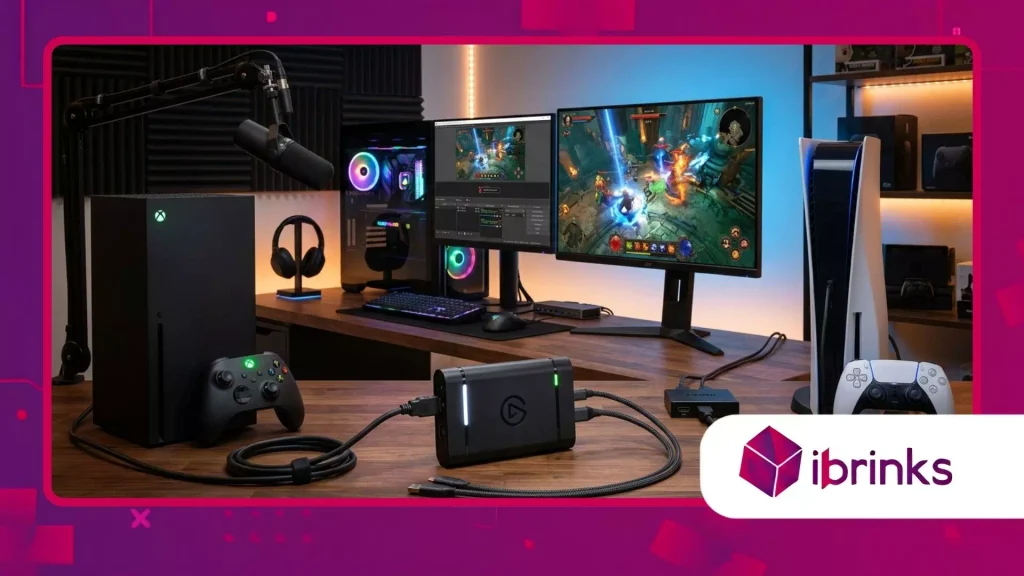
Which Pass-Through Features Matter Most for PS5 and Xbox Series X?
Selezione external capture gear requires choosing input parameters that match the exact video output specifications of current-generation gaming hardware.
If your console outputs 4K resolution at 120 frames per second with HDR enabled, your capture box must feature HDMI 2.1 pass-through capability.
Skimping on HDMI bandwidth forces your console to downgrade monitor output, introducing unwanted motion blur and disabling variable refresh rate features.
Choosing gear with zero-latency pass-through guarantees that what you see on your gaming monitor remains completely synchronized with your physical controller inputs.
Leggi anche: Guida al software e alla personalizzazione delle tastiere RGB
How Do You Connect Audio and Video Pipelines for Seamless Recording?
Setting up a robust video pipeline requires running an HDMI cable from your console directly into the capture card’s input port.
Next, connect a second high-speed HDMI cable from the card’s pass-through output straight into your low-latency gaming monitor.
Connect the USB output cable into a fast motherboard port on your computer, ensuring high transfer rates for raw video data streams.
Finally, integrate a chat link analog audio splitter if you need to capture encrypted voice channels, party chats, or wireless headset signals simultaneously.
Per saperne di più: I migliori case per PC per flusso d'aria ed estetica
How Do Popular Capture Hardware Options Compare for Streamers?
Evaluating hardware choices depends heavily on whether your primary focus centers on high-resolution archiving, high-frame-rate competitive gaming, or extreme portability.
Premium units feature dedicated onboard DSP chips that lower host CPU utilization, while entry-level alternatives rely entirely on software encoding within your desktop streaming application.
Identifying your exact output goals prevents spending extra money on unused HDMI 2.1 features or purchasing underpowered gear that bottlenecks your broadcast.
The following table highlights core performance specifications across standard equipment classes available to creators today.
| Capture Equipment Class | Maximum Pass-Through | Maximum Capture Resolution | Host Interface | Primary Creator Benefit |
| Entry-Level USB 3.0 | 1080p @ 60Hz | 1080p @ 60Hz | USB 3.0 (5 Gbps) | Affordable plug-and-play setup for beginners. |
| Mid-Range Pro USB | 4K @ 60Hz / 1440p @ 120Hz | 4K @ 30Hz / 1080p @ 120Hz | USB 3.2 Gen 1 | Balanced cost with high refresh rate pass-through. |
| Flagship HDMI 2.1 | 4K @ 1440Hz / 4K @ 120Hz VRR | 4K @ 60Hz / 1080p @ 240Hz | USB 3.2 Gen 2 | Full console feature preservation without compromise. |
What Troubleshoot Solutions Keep Capture Signals Stable?
How Do You Fix HDCP Handshake Errors and Black Screens?
Black screen issues during video setup almost always trace back to High-bandwidth Digital Content Protection (HDCP) settings on your gaming console.
Modern consoles automatically enable HDCP encryption when playing media apps like Netflix, which intentionally blocks video signals from passing through recording hardware.
To restore video feeds, navigate into system settings on your PlayStation console and manually uncheck the HDCP toggle option.
Additionally, ensure your system firmware is updated, try alternative high-speed HDMI cables, and avoid running video through unpowered external HDMI switches.
How Can You Eliminate Latency and Audio Desync During Live Streams?
Audio latency often occurs when streaming software processes video frame rates at a slightly different pace than incoming USB audio signals.
To maintain perfect lip sync and game audio alignment, always select sample rate values of 48kHz across all software settings and hardware interfaces.
Isn’t it frustrating when a dramatic headshot sound fires half a second after the action happens on screen?
Using reliable external capture gear with dedicated driver management tools prevents audio drift, keeping your gaming audio perfectly aligned like a well-calibrated physical clock mechanism.
How Do You Optimize Video Bitrates for Uncompressed Stream Output?
Achieving professional video quality requires setting correct encoding bitrates inside OBS Studio or Streamlabs based on your streaming platform’s upload capacity.
For 1080p streams running at 60 frames per second, aim for an encoding bitrate between 6,000 Kbps and 8,000 Kbps using NVENC or AMD VCE video encoders.
If you record gameplay locally to your solid-state drive, utilize CQP or CRF quality modes instead of static bitrates to preserve fast movement detail.
Proper bitrate management guarantees that high-speed gameplay clips stay crisp, clean, and completely free from distracting compression artifacts.
Elevating Your Gaming Broadcast Quality
Upgrading your content strategy with reliable external capture gear unlocks complete control over visual fidelity, channel audio tracks, and stream presentation.
Modern audience expectations demand clean visual broadcasts free from frame drops, laggy audio, or muddy video compression.
Equipping your desk with dedicated capture hardware bridges the gap between raw console power and professional broadcast distribution networks.
Take time to audit your cable quality, configure software drivers properly, and experiment with audio mixing pathways to deliver pristine gaming content.
Domande frequenti
What is the difference between an internal and external video capture card?
Internal capture cards install directly into a desktop PC motherboard via PCIe slots, offering high data bandwidth and zero cable clutter.
External capture cards connect using USB ports, making them portable and compatible with laptops, compact PCs, and multiple console setups without opening computer cases.
Do I need a powerful computer to use an external capture card with my console?
Yes, your computer needs a capable graphics card and multi-core processor to handle real-time video encoding within OBS or Streamlabs.
While the capture card processes video signals, your PC’s GPU or CPU still encodes that video stream into playable streaming formats.
Why is my external capture card showing a black screen when connected to a PS5?
A black screen usually indicates that HDCP (High-bandwidth Digital Content Protection) is currently enabled in your PS5 system settings.
Disabling HDCP inside the console’s system menu immediately allows unencrypted video signals to pass directly into your capture device input.
Can external capture cards pass through 4K 120Hz signals with VRR enabled?
Only capture devices equipped with full HDMI 2.1 pass-through hardware support 4K resolution at 120Hz along with Variable Refresh Rate (VRR).
Older HDMI 2.0 capture cards cap output signals at 4K 60Hz or downscale high-refresh rates down to 1080p.
Do external capture cards record party chat audio automatically?
External capture cards only process audio sent through the console’s HDMI output connection by default.
Capturing controller-connected headset audio or party voice channels requires using an analog chat link cable or configuring specific console audio output routing options.
